Overhead lines: twenty feet, and look up twice
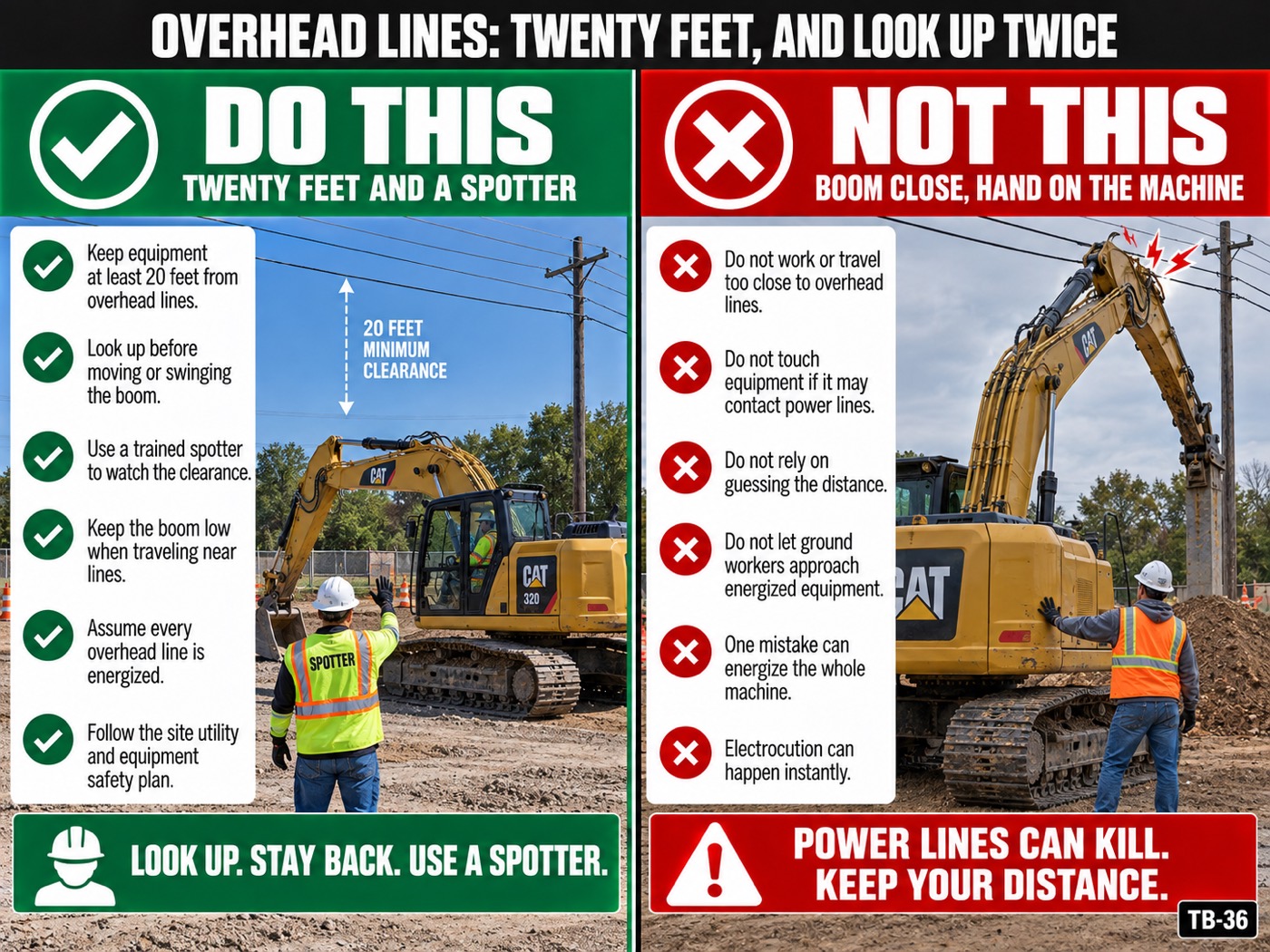
You cannot tell a live line from a dead one by looking at it, and nobody is going to come tell you.
The points
- Treat every overhead line as live and bare. You cannot tell by looking, and the utility will not have told you.
- For lines up to 350 kV keep everything twenty feet clear - boom, load, rigging, hands - unless the line is de-energized and visibly grounded, or the utility confirms the voltage so the Table A distance can be used.
- Look up at every setup, and again any time the machine moves. The clearance you measured is for where the machine was.
- If equipment does contact a line, stay on the machine. The ground around it is energized. Only if it catches fire, jump clear with both feet together and shuffle away without lifting a foot.
- A spotter whose only job is watching that clearance is worth more than the tape measure.
Why it goes wrong
Overhead power lines kill people in this trade every year, and the pattern is almost always the same: the crew knew the line was there. They looked at it in the morning, set up clear of it, and then the machine moved, or the boom swung, or the load swung, and the clearance they measured was for where the machine used to be.
For lines up to 350 kV the default clearance is twenty feet for everything - boom, load, rigging, tag line, hands. Above that it grows. Working closer takes the utility: either it de-energizes the line and it is visibly grounded, or it confirms the voltage so the smaller Table A distance can be used. That is a phone call and a confirmation, not an assumption. Twenty feet is the equipment number, and it is longer than the ten feet you may have heard for people on foot - once a crane or a boom is in the picture, twenty is the default.
Twenty feet is further than it looks from the seat of a machine. Depth perception at that angle is poor and the line is thin against the sky, which is exactly why a dedicated spotter - someone whose only job is watching that gap, with no other task - catches what the operator cannot.
If contact does happen, the machine is the safest place to be, because you are not part of the path to ground. The danger is the ground itself: voltage spreads outward through the soil in rings, and stepping across those rings puts a difference in potential between your two feet. That is why the escape, if fire forces one, is to jump clear without touching machine and ground at once, land with feet together, and shuffle away without ever separating your feet.
Questions for the crew
- Where is the nearest line to where we are working, and how far is it really?
- Who is the spotter today, and do they have any other job?
- What happens on this site when the machine has to reposition?
To close
Before anything goes up today, we all look up together and I want somebody's finger pointing at the line.
To hold this talk with your crew
1
Read it aloud. Five minutes, before the work starts.
2
Ask the questions. A crew that talks is a crew that remembers.
3
Have them sign on their own phones, and the record is sealed.