Asbestos in older systems: stop before you cut
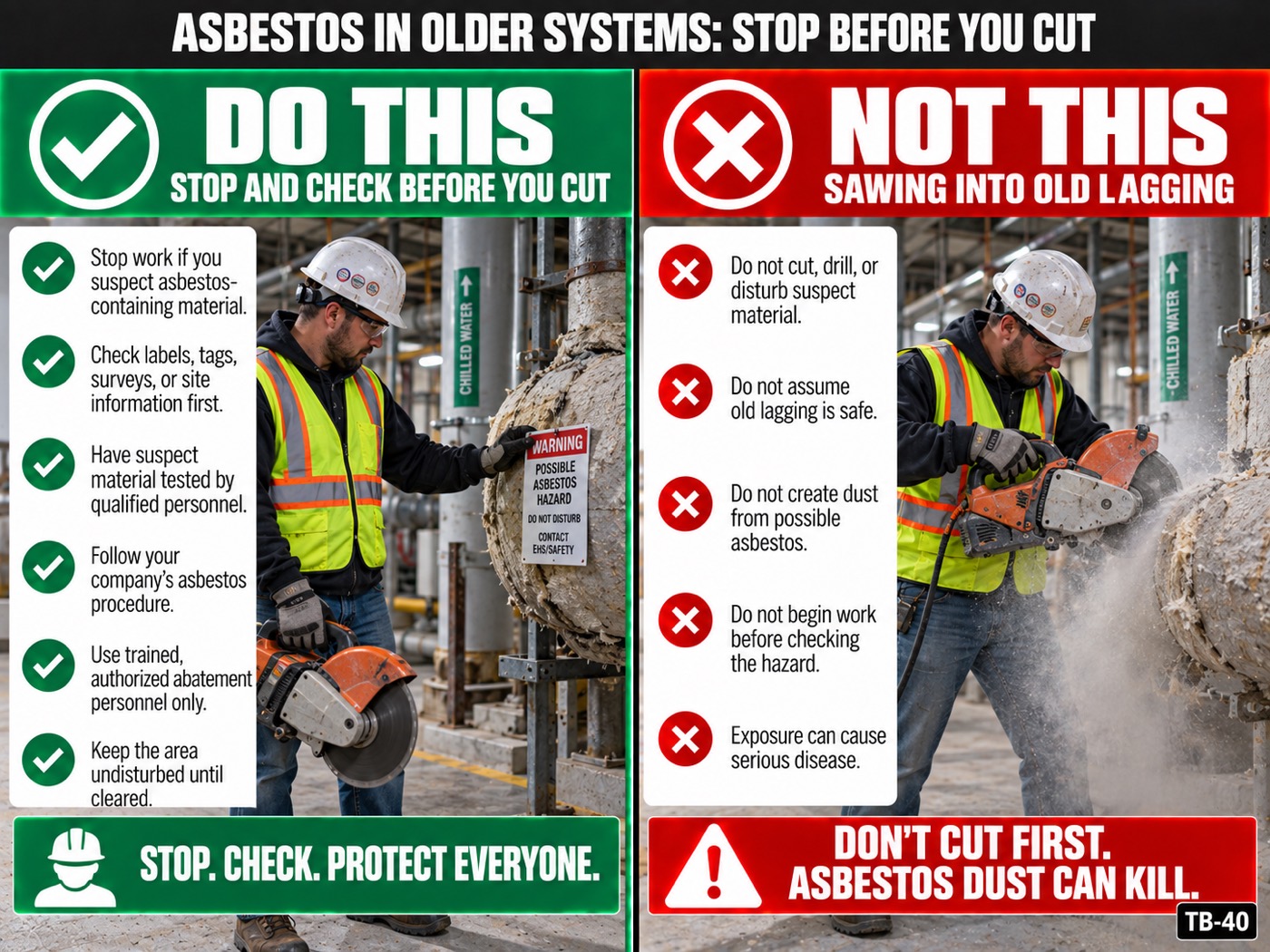
If this building went up before the mid-eighties, the rule today is simple: find out what it is before you cut it.
The points
- Pipe lagging, duct wrap, boiler insulation, gaskets and floor tile in older buildings can all contain asbestos.
- You cannot tell by looking. Before you cut, strip or drill in a building from before the mid-1980s, find out what it is.
- If it might be asbestos, stop. Disturbing it is what releases fibers - material left intact is not the hazard.
- This is regulated work with its own training and rules, and abatement often needs a certified contractor. It is not something to finish quickly before anyone notices.
- Fibers ride home on clothes. That is how families end up affected by work they never did.
Why it goes wrong
Asbestos was used because it worked. It is in pipe lagging, duct wrap, boiler insulation, gaskets, mastic, floor tile and the adhesive under it, roofing felt, and joint compound. In a building from before the mid-1980s any of those can contain it, and a lot of material installed for years after that does too.
The thing that makes this different from most hazards is the delay. Fibers you breathe today do nothing you can feel for twenty or thirty years, and then cause diseases with no cure. There is no version of this where you find out quickly enough to change course.
Material sitting there intact is not the hazard. Cutting it, drilling it, sanding it, ripping it out - that is what puts fibers in the air, which is why the answer to a suspicion is always to stop rather than to hurry up and finish. You cannot identify it by looking; that requires a sample and a lab.
This is regulated work with its own training, containment and disposal rules, and abatement often needs a certified contractor, and the reason those rules are heavy is that it is not just your exposure. Fibers ride home on clothes and hair. Family members of workers have died of asbestos disease without ever setting foot on a job site.
Questions for the crew
- How old is this building, and does anyone know what has already been surveyed?
- What are we cutting, drilling or removing today?
- Who do we call if we find something suspect?
To close
If you hit something you are not sure about, stop and come get me. Nobody is going to be annoyed about that.
To hold this talk with your crew
1
Read it aloud. Five minutes, before the work starts.
2
Ask the questions. A crew that talks is a crew that remembers.
3
Have them sign on their own phones, and the record is sealed.