Hydro-vac wand: 3,000 PSI cuts skin and gas pipe
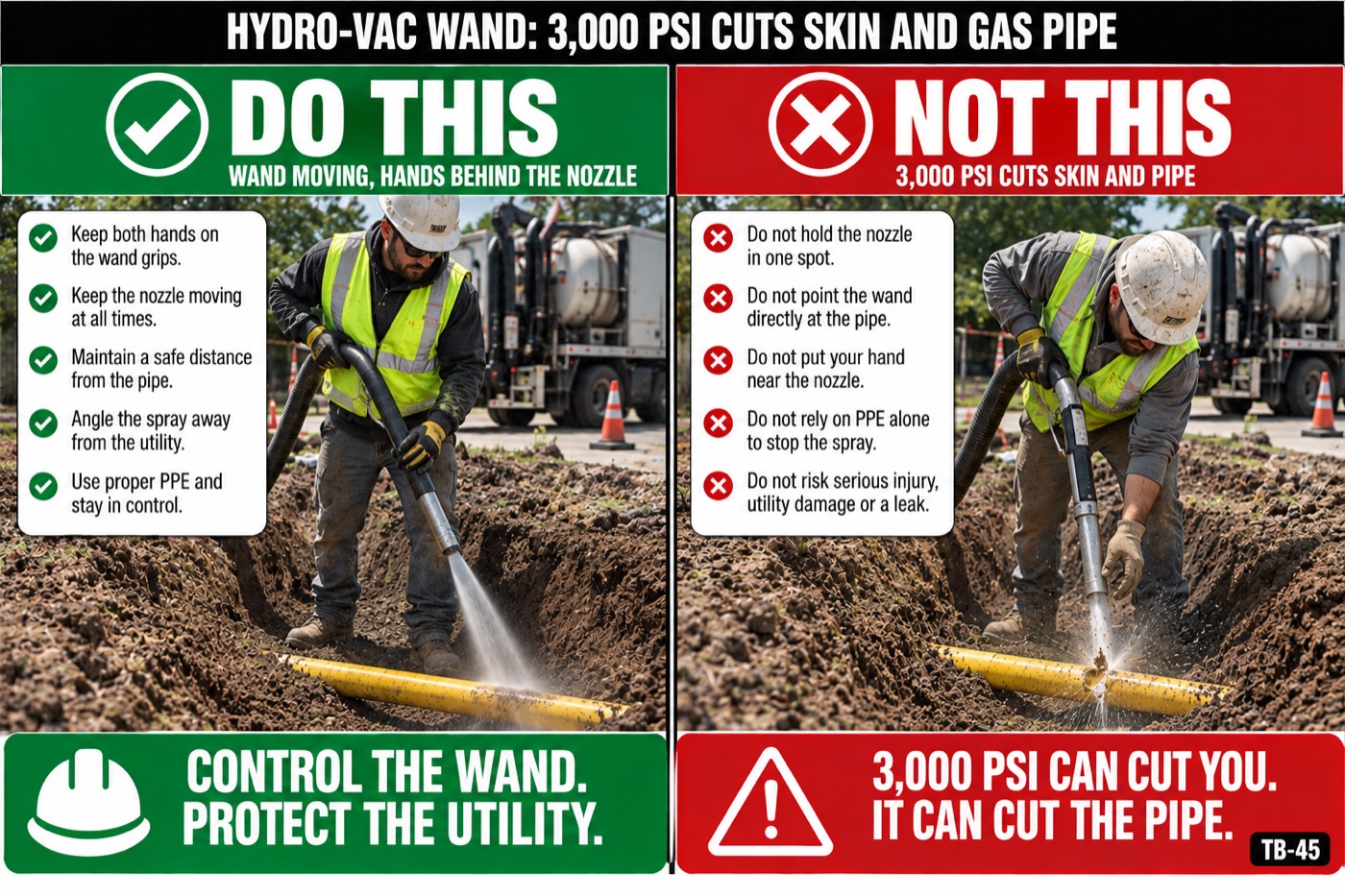
The water coming out of that wand is at 2,500 to 3,000 PSI. It takes about 100 PSI to break skin, and at 3,000 the water goes in and keeps going, along the tendons, up the arm.
The points
- A wand across a hand injects water and dirt under the skin. It looks like a small cut, and by the next day the hand is swelling and a surgeon is deciding how much to open up.
- The wand is a cutting tool. Never point it at anyone, never at your own feet, and never set it down running.
- Work with the tip at about 45 degrees and 6 to 8 inches off the ground, and keep it moving. Held still, a 3,000 PSI stream cuts through polyethylene gas pipe in seconds.
- Cut across the line and away from it, never along the pipe and never toward it. When you see the top of the line, drop the pressure and switch to a rotating or fan nozzle.
- Gloves, face shield, waterproof boots and a rain suit are the minimum for the person on the wand. A soaked crew in a cold hole gets careless fast.
Why it goes wrong
A high-pressure injection injury does not look like much. The entry wound may be the size of a pencil lead. The water carries soil, bacteria and sometimes hydraulic fluid deep into the tissue, and the pressure strips tissue away along the path. Untreated, these lose fingers and hands. Anyone hit by the stream goes to the emergency room that hour and tells them it was a high-pressure injection.
The reason to keep the wand moving is dwell time. Water at 3,000 PSI erodes soil by breaking it up, and it erodes plastic and fiber jackets the same way, just slower. A second on a spot is digging; five seconds on a spot is cutting. The rotating nozzle spreads the energy and is what you switch to when you are close to the line.
The angle matters because a stream going straight down next to a pipe walks under it and undermines it, and a stream pointed toward the pipe hits it square. 45 degrees, cutting across the line, moves soil away and leaves the pipe on its bed. Once the line is exposed, it gets supported, not left hanging. That is what 29 CFR 1926.651 means by safe and acceptable means and by protecting the exposed utility.
Cast iron and steel take the water. Polyethylene gas, PVC water, fiber, and direct-buried cable do not. The ticket colors tell you what is likely under you; yellow and orange mean you back off the pressure before you reach the depth on the ticket.
The common mistake is turning the pressure up to make the job go faster in hard clay or frozen ground. Higher pressure with a narrow nozzle is exactly the stream that slices a service. Use heat, a bigger nozzle or more time instead.
The person on the wand controls the water and nobody else stands in the hole with them. The hose jumps when the trigger opens, and the spray throws rocks. Everyone else stays back until the trigger is off.
Questions for the crew
- What colors are marked in the hole we are potholing today, and what pressure are we starting at?
- Which nozzle is on the wand right now, and when do we swap it?
- If the stream hits someone's hand, where is the nearest emergency room and who drives?
To close
Nobody on the wand today cuts toward a marked line, and the pressure comes down before we get to ticket depth.
To hold this talk with your crew
1
Read it aloud. Five minutes, before the work starts.
2
Ask the questions. A crew that talks is a crew that remembers.
3
Have them sign on their own phones, and the record is sealed.