Debris tank door: never stand in the swing
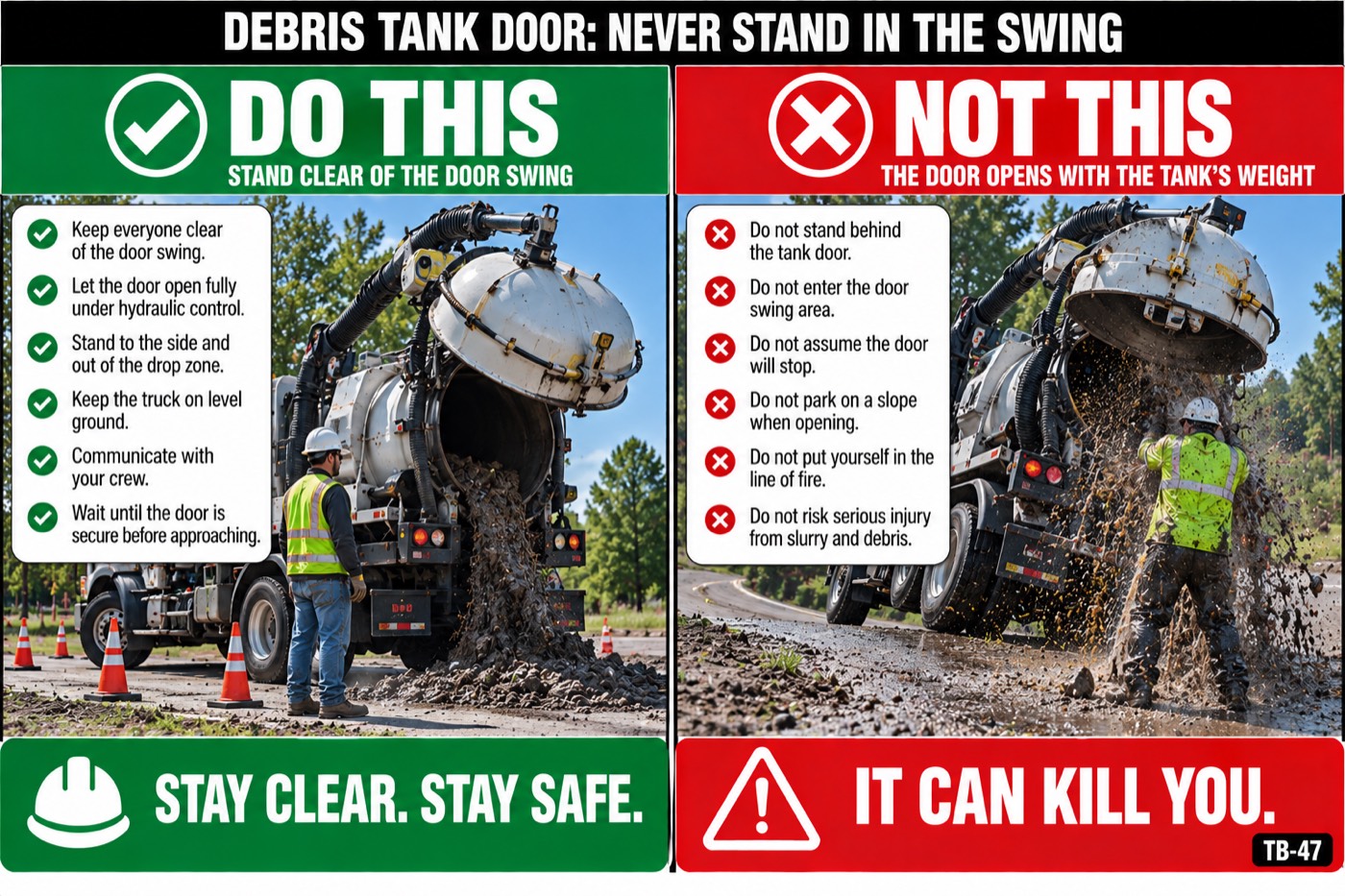
The rear door on the tank weighs 1,500 to 2,500 pounds, and the tank behind it can hold 30,000 pounds of wet slurry. Both of them want to come at whoever is standing behind the truck.
The points
- A door that swings with someone in its arc, or a tank that tips over on a slope, is a fatality. The door does not stop and the slurry does not stop.
- Before the door opens, the tank is vented. A tank still under vacuum pulls the door shut on your hands; a tank still under off-load pressure blows it open.
- Open the door from the side, at the control, with nobody in the swing. Then pin or latch it in the open position; a door held only on its cylinder can close on you.
- Raise the tank only on level, firm ground. Slurry sloshing in a raised tank on a side slope rolls the truck.
- Never go under a raised tank or door without the positive lock, block or prop in place. The hydraulic cylinder is not a support.
Why it goes wrong
Vacuum trucks pull down to 16 to 28 inches of mercury and some off-load under positive pressure of up to 15 PSI. Both are a load on the door. 15 PSI across a door 5 feet in diameter is about 40,000 pounds, which is why the latches are as big as they are, and why the tank is vented to zero before anyone touches a latch.
The door is on a hinge and a hydraulic cylinder. When it swings, it carries the weight of the door plus whatever slurry is packed against it. Slurry has stuck to the door and let go all at once, and it has dropped a 500-pound slab of set mud onto whoever was looking in. Stand to the hinge side, out of the arc, until the flow stops.
29 CFR 1926.601 requires trucks with dump bodies to have a positive means of support, permanently attached and lockable, to prevent accidental lowering during maintenance or inspection. A vacuum tank that tilts is a dump body for this purpose. The prop is there because cylinders bleed down and hoses split, and a tank coming down does not warn you.
Center of gravity is the problem on a slope. A raised 12-yard tank puts 30,000 pounds 10 to 12 feet in the air. Two or three degrees of side slope and the slurry moving toward the low side is enough to lift the high-side wheels. Level ground, outriggers down if the truck has them, and the truck pointed straight up or down any grade, never across it.
The common mistake is having somebody at the back to watch the flow and tell the operator when it is empty. The camera or a mirror does that. A person can do it from 20 feet to the side, never from behind the door, and never where the operator cannot see them.
Cold weather adds a step. Slurry freezes to the door seal and the latches, and the door comes open with a bang when it lets go. Thaw it; do not pry it with someone standing where it will land.
Questions for the crew
- Where are we dumping today, and is it level enough to raise the tank?
- Who is opening the door, where are they standing, and where is everybody else?
- What is the vent procedure on this truck, and how do you know the tank is at zero?
To close
Today the tank vents to zero, the door opens with nobody in the swing, and nobody goes under a raised tank without the prop in.
To hold this talk with your crew
1
Read it aloud. Five minutes, before the work starts.
2
Ask the questions. A crew that talks is a crew that remembers.
3
Have them sign on their own phones, and the record is sealed.