Sewer gas: the smell you stop smelling
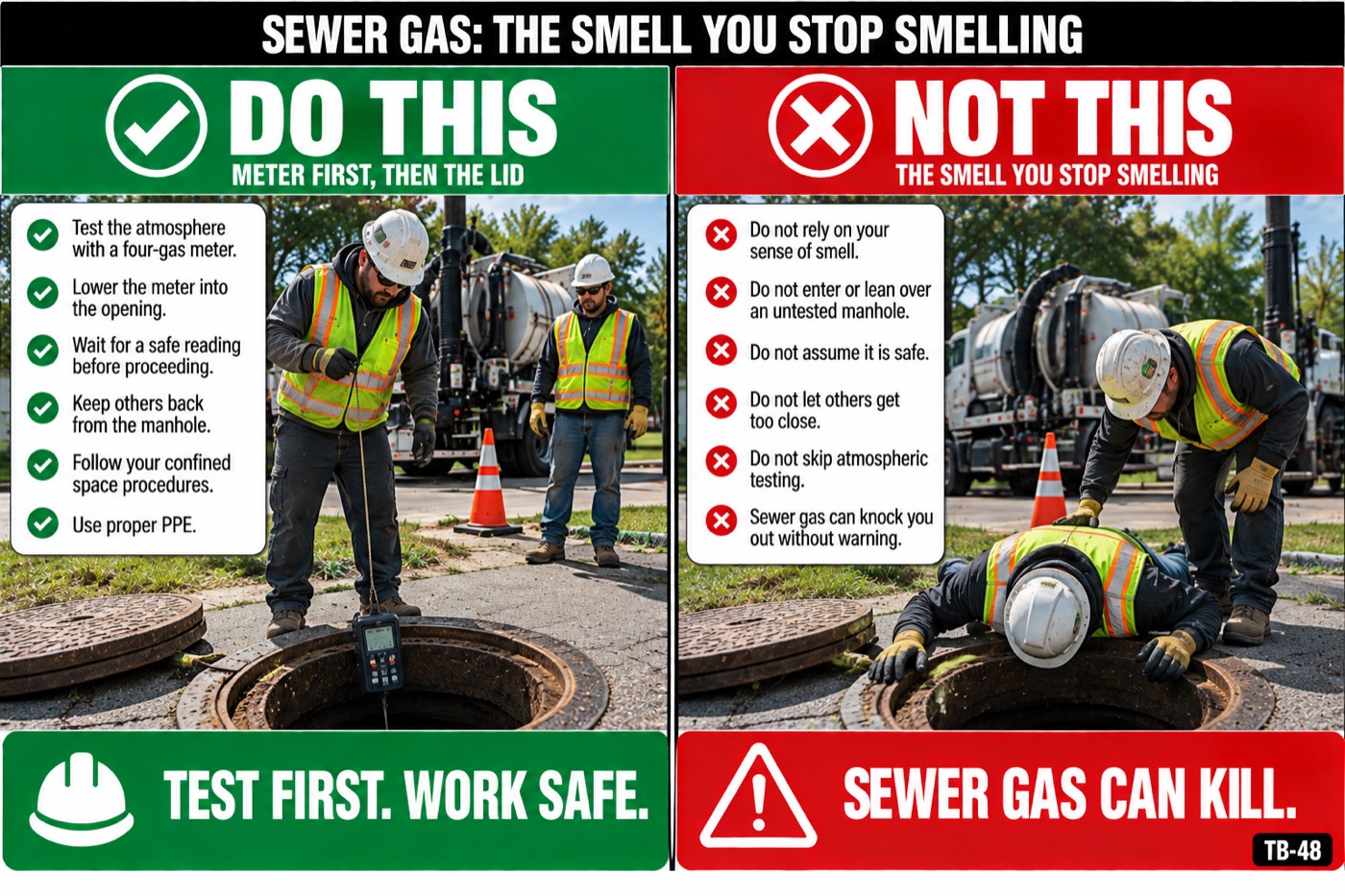
You can smell hydrogen sulfide at a fraction of a part per million. At around 100 parts per million it kills your sense of smell within minutes, and the air seems to get better right as it is getting worse.
The points
- Hydrogen sulfide at 500 to 700 parts per million puts you on the ground within minutes. Near 1,000 it can take a single breath, and the person who goes in after you is the second body.
- The construction limit in 29 CFR 1926.55 is 10 ppm over a shift. 100 ppm is the level NIOSH calls immediately dangerous to life and health, and the meter alarms well before that.
- Every manhole, wet well, lift station and sewer lateral is tested before anyone leans in. The meter goes down first, on a line, at the top, middle and bottom.
- The gas is heavier than air and sits in the low spots. The reading at the rim tells you nothing about the reading 4 feet down or downwind behind the truck.
- When the meter alarms, everybody backs out upwind and the vacuum stays off. Nobody goes back in until it is ventilated and reads clear, and nobody ever goes in after a person who is down.
Why it goes wrong
Hydrogen sulfide comes from sewage, sludge, stagnant water and rotting anything. Vacuuming a wet well stirs the bottom and releases what was trapped in the sludge, so the reading goes up when the work starts, not before. The tank on the truck then holds it, and the tank vent and the rear door release it later at the dump site.
The smell threshold is about 0.01 to 1 ppm. Above about 100 ppm the nerve that smells it stops working, which is called olfactory fatigue. The construction table at 29 CFR 1926.55 lists it at 10 ppm as an 8-hour limit; the general industry table sets a 20 ppm ceiling; NIOSH calls 100 ppm immediately dangerous to life and health. At 500 to 700 ppm people collapse within minutes, and at 1,000 ppm breathing stops.
The meter is a four-gas monitor: oxygen, flammable gas, hydrogen sulfide, carbon monoxide. It gets bump tested before the shift with test gas, not just turned on. A meter that has not seen gas since it was calibrated may read zero in a fatal atmosphere. The alarm setpoints are usually 10 ppm low and 15 ppm high for hydrogen sulfide; treat the low alarm as a stop.
Manholes near a vac truck have a second hazard: the truck exhaust. Carbon monoxide from a diesel idling at high RPM for the vacuum settles into a hole 10 feet away. Park downwind, or run the exhaust stack up and away from the opening.
The common mistake is treating the meter reading at the rim as the reading in the hole, and treating a hole the crew has worked before as a known quantity. Yesterday's clear reading is not today's. The sludge that got disturbed yesterday is off-gassing today.
Rescue is a permit space rescue: retrieval line, tripod, supplied air, people who have practiced it. Most deaths in these spaces are the second and third people in. If someone drops, call 911, get air moving into the space, and stay out.
Questions for the crew
- What did the meter read at the top, middle and bottom of this hole, and when was it bump tested?
- Where is the truck exhaust going relative to the opening today?
- If someone goes down in there, what is the retrieval, and who has practiced it?
To close
Nobody leans into any manhole or wet well today until the meter has been down the hole and reads clear.
To hold this talk with your crew
1
Read it aloud. Five minutes, before the work starts.
2
Ask the questions. A crew that talks is a crew that remembers.
3
Have them sign on their own phones, and the record is sealed.