Extension cords and temporary power
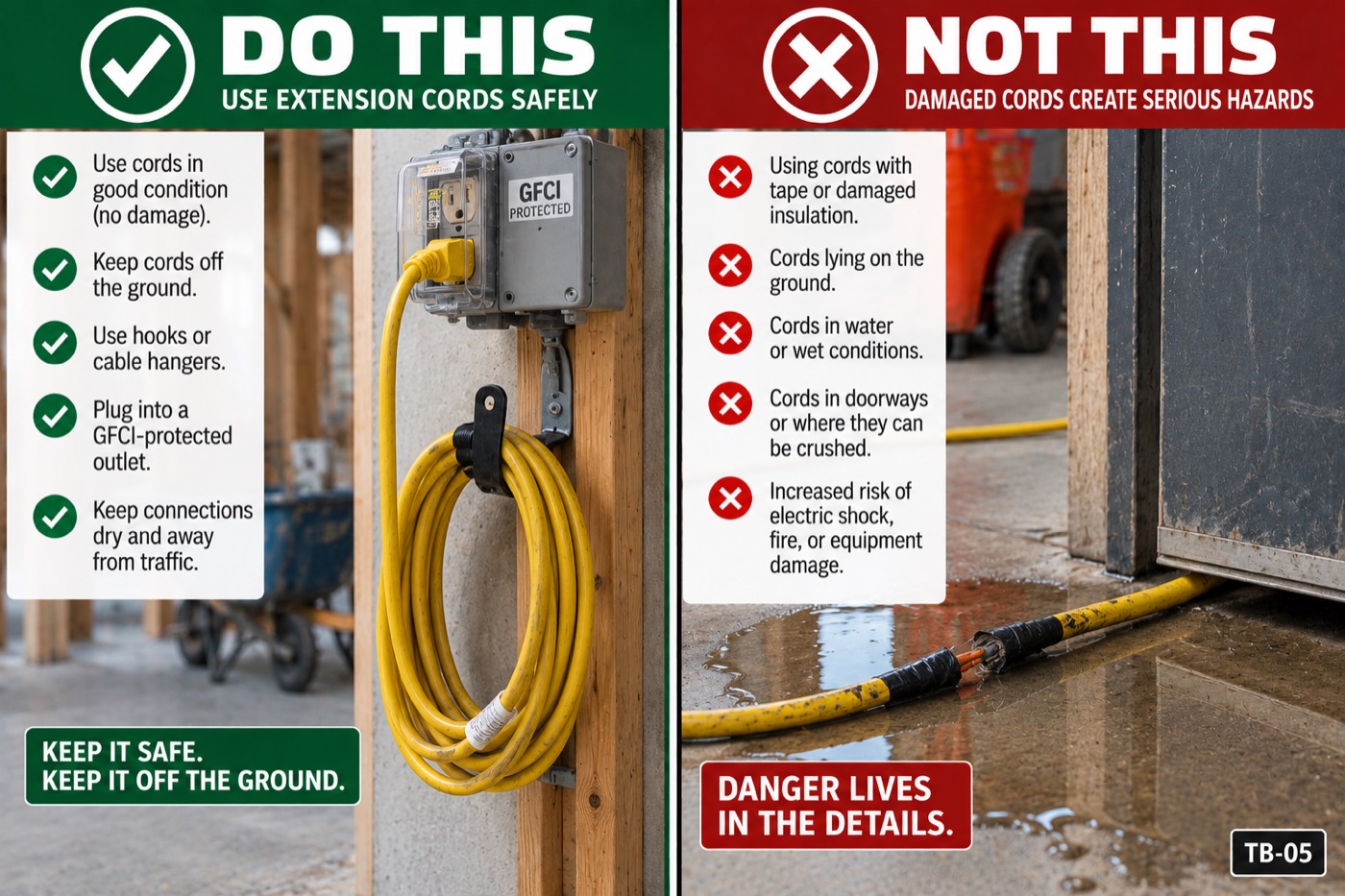
Show me your cord. If the jacket is cut anywhere along it, that cord is done today - not taped, done.
The points
- Every cord on site gets looked at before it gets plugged in. Cut jackets, exposed copper, or a missing ground pin means it is trash, not tape.
- Use GFCI protection on every temporary circuit. Test it, do not assume it.
- Cords are not for hoisting, hanging, or pulling equipment.
- Run cords where people are not walking. A cord across a doorway is a trip hazard and a damaged cord waiting to happen.
- Indoor-rated cords stay indoors.
Why it goes wrong
A cord jacket is insulation, and it is the only thing between a conductor and whoever picks up the cord. Once it is cut through, tape does not restore it - tape does not restore the jacket's strength or its hard-use rating, it comes loose with heat and handling, and it hides the damage from the next person who inspects the cord. A damaged cord gets cut off at the plug and thrown away, so nobody can put it back in service.
The missing ground pin is the failure that gives no symptom. Break it off and the cord still runs the tool perfectly, which is precisely the danger: the fault path is gone, and nothing tells you until a tool goes to ground through its case and the case is live in someone's hand.
Cords fail where they get abused, and the abuse is almost always the same three things - pulled by the cord instead of the plug, run over by traffic, and used to hoist or hang something. All three damage the conductors inside a jacket that still looks fine from outside, which is why the ends and the flex points get the most attention on inspection.
Routing is a safety issue twice over. A cord across a walkway is a trip hazard now and a damaged cord later, because everything that rolls across it is grinding the jacket. Overhead or along a wall solves both at once.
Indoor-rated cords are built for a dry, protected environment and their jackets break down outside. If it is going outdoors, in wet, or through weather, it needs to be rated for it - the marking is printed on the jacket.
Questions for the crew
- Take a look at the cord you will use today. What condition are the ends in?
- Where are cords running on this site, and does anyone have to step over one?
- Is anything outside on a cord that is only rated for indoors?
To close
Look at both ends and the whole length before you plug in. It takes ten seconds.
To hold this talk with your crew
1
Read it aloud. Five minutes, before the work starts.
2
Ask the questions. A crew that talks is a crew that remembers.
3
Have them sign on their own phones, and the record is sealed.