Lane closure: the taper, the cones and the second truck
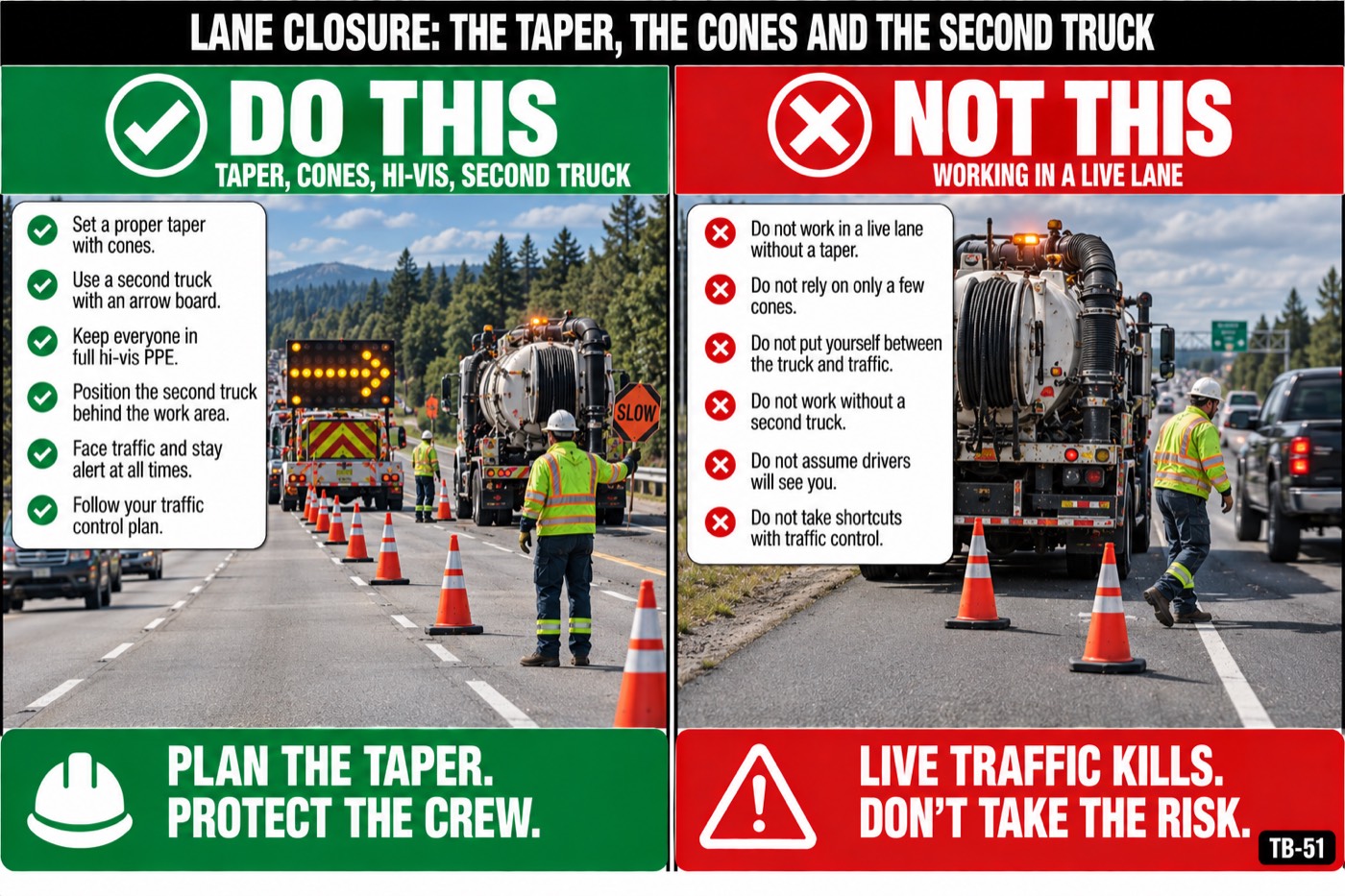
A car at 45 miles per hour covers 66 feet every second. The driver looking at their phone sees the first cone with about 2 seconds to react, which is why the taper is 540 feet long and not 50.
The points
- A vac truck on the shoulder with a hose across the lane and a crew around a manhole is a target. The car that hits the taper hits the truck, and the person between them is the one who dies.
- Flagging and the traffic control setup follow Part 6 of the MUTCD, by rule under 29 CFR 1926.201. That is the taper length, the cone spacing, the signs, and the flagger's vest and paddle.
- Taper length at 45 mph and up is lane width times speed: a 12-foot lane at 45 mph is 540 feet of cones. Cone spacing in the taper is about the speed in feet, 45 feet apart at 45 mph.
- Everyone outside the truck is in high-vis: Class 2 minimum, Class 3 at night or over 50 mph. The spotter watches traffic and nothing else, and the crew works facing traffic.
- The second truck, a shadow vehicle or an attenuator truck, sits in the buffer between traffic and the crew. It is there to get hit instead of you.
Why it goes wrong
29 CFR 1926.201 says flaggers and flagging conform to Part 6 of the Manual on Uniform Traffic Control Devices, and 1926.200 says the same for signs and devices. Part 6 is where the taper formulas and the cone spacing come from: taper length L equals lane width times speed for 45 mph and over; below that it is width times speed squared divided by 60. So a 12-foot lane at 30 mph needs a 180-foot taper; at 55 mph it needs 660 feet.
The advance warning signs start a long way back, on a 45 mph road typically 500 feet apart with the first one at least 1,500 feet before the work. Drivers need the distance to notice, decide and slow down. A closure with a good taper and no advance signs still gets hit.
The hose across the lane is a hazard nobody plans for. A live suction hose in the road is a trip for a pedestrian and an obstacle a driver swerves around into the next lane or into the crew. Route the hose along the closed lane, cone it, and never drag it across a live lane.
The spotter stands where they can see approaching traffic and the crew, has an air horn or a signal everyone knows, and does not run the vacuum, pull hose, or look at a phone. When the horn goes, everyone moves toward the escape route agreed at the start, which is away from traffic, not toward the truck.
The common mistake is setting cones for the job as it is at 7 a.m. and leaving them as traffic builds, the light changes, or the truck moves to the next manhole. Every time the truck moves, the closure moves with it. Every hour, somebody walks the taper and stands the knocked-over cones back up.
At night, the closure needs lights on the taper, a lit arrow board if the lane is closed, and Class 3 garments. Strobes on the truck are not a substitute for a taper.
Questions for the crew
- What is the posted speed here, how long is our taper, and did anyone measure it?
- Who is the spotter today, where do they stand, and what is the signal?
- Which way does everyone run if a car comes through?
To close
Today the taper gets measured, the spotter does nothing but watch traffic, and the hose never crosses a live lane.
To hold this talk with your crew
1
Read it aloud. Five minutes, before the work starts.
2
Ask the questions. A crew that talks is a crew that remembers.
3
Have them sign on their own phones, and the record is sealed.