Off-loading slurry: the edge that gives
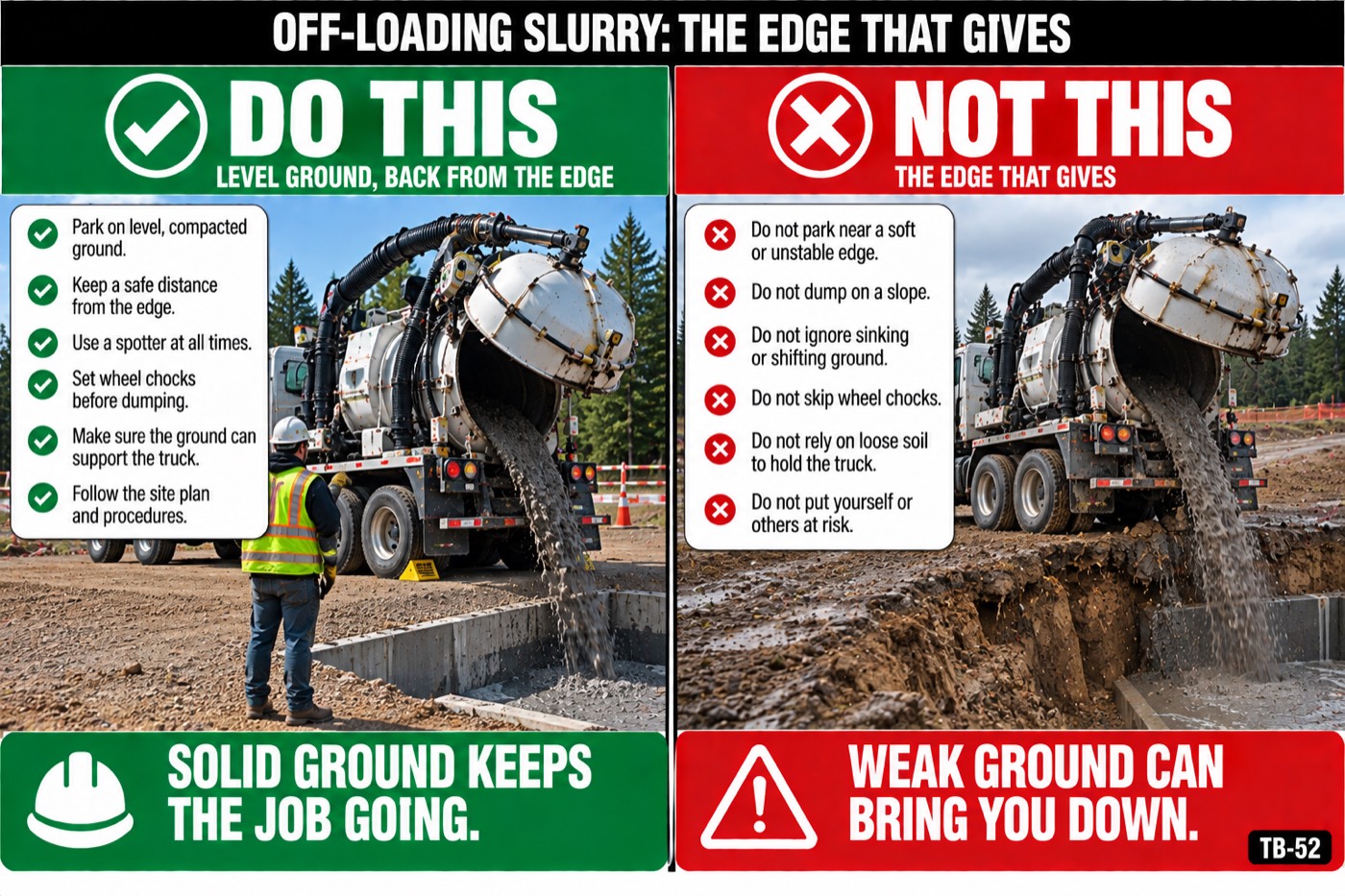
Twelve yards of wet slurry is 30,000 to 36,000 pounds sitting behind the cab. When you back that to the edge of a pit, the edge is holding a loaded truck on ground that was dug up last week.
The points
- A rear wheel goes through the edge of a pit, the tank is up, and the truck goes over backwards or onto its side with the operator in the cab. There is no jumping clear of that.
- Backing a truck with an obstructed rear view takes a working backup alarm or an observer who signals it is safe, under 29 CFR 1926.601. At a pit you use both, and the observer stands to the side, never behind.
- Stop short of the edge by at least the depth of the pit, and use a wheel stop or a berm the truck cannot climb. Ground near a pit edge is loose fill and it fails under a loaded axle.
- Level ground before the tank goes up. On a slope, the slurry runs to the low side and the truck follows it.
- Spoils go where the ticket or the owner says they go. Not down a storm drain, not on the shoulder, and not in a stormwater pond that then has to be dug out.
Why it goes wrong
The load is water and dirt, so it is heavy and it moves. A typical 12-yard tank of hydro-excavation slurry weighs 30,000 pounds or more; with the water tank and the truck, the rig is at or near a 66,000-pound gross weight. The rear axles carry most of it, and they carry more of it when the tank is raised and the slurry slides to the door.
Pit edges fail for the same reasons trench walls do: they are unsupported vertical faces in disturbed soil, and the load on top is exactly what they were not built for. The rule of thumb is a setback from the edge equal to the depth of the pit. A stop log or berm at the setback is what makes the setback real when the driver cannot see the edge in the mirror.
Backing is the most dangerous minute of the dump. Under 29 CFR 1926.601 a vehicle with an obstructed rear view backs only with an audible alarm or an observer's signal. The observer stands to the driver's side where the driver can see them in the mirror, gives a stop signal that means stop, and never stands between the truck and the edge to wave it back.
Raising the tank changes the truck. The center of gravity goes up 10 feet, the wind catches the tank, and anything overhead is now in reach: a power line, a tree limb, a roof edge. Look up before the tank goes up, and never move the truck with the tank raised, even a few feet.
The common mistake is off-loading where it is convenient instead of where it is permitted: a vacant lot, a construction site's stockpile, a swale. Slurry can carry whatever was in the hole, including sewage and fuel. It goes to the site on the ticket, with a manifest if the material calls for one, and the driver knows the address before the tank is full.
Pressure off-loading pushes slurry out with 10 to 15 PSI of air. Nobody stands in front of the door for that, and the truck is bonded if the load is anything that could hold vapor.
Questions for the crew
- Where is the dump site for today's loads, and has anyone walked the edge there?
- Who is spotting the truck back, and where exactly do they stand?
- What is in this slurry, and does it need paperwork?
To close
Today the truck stops a pit depth short of any edge, backs only on the spotter's signal, and the tank goes up on level ground only.
To hold this talk with your crew
1
Read it aloud. Five minutes, before the work starts.
2
Ask the questions. A crew that talks is a crew that remembers.
3
Have them sign on their own phones, and the record is sealed.