Vacuuming flammables: static, vapor and the truck's rating
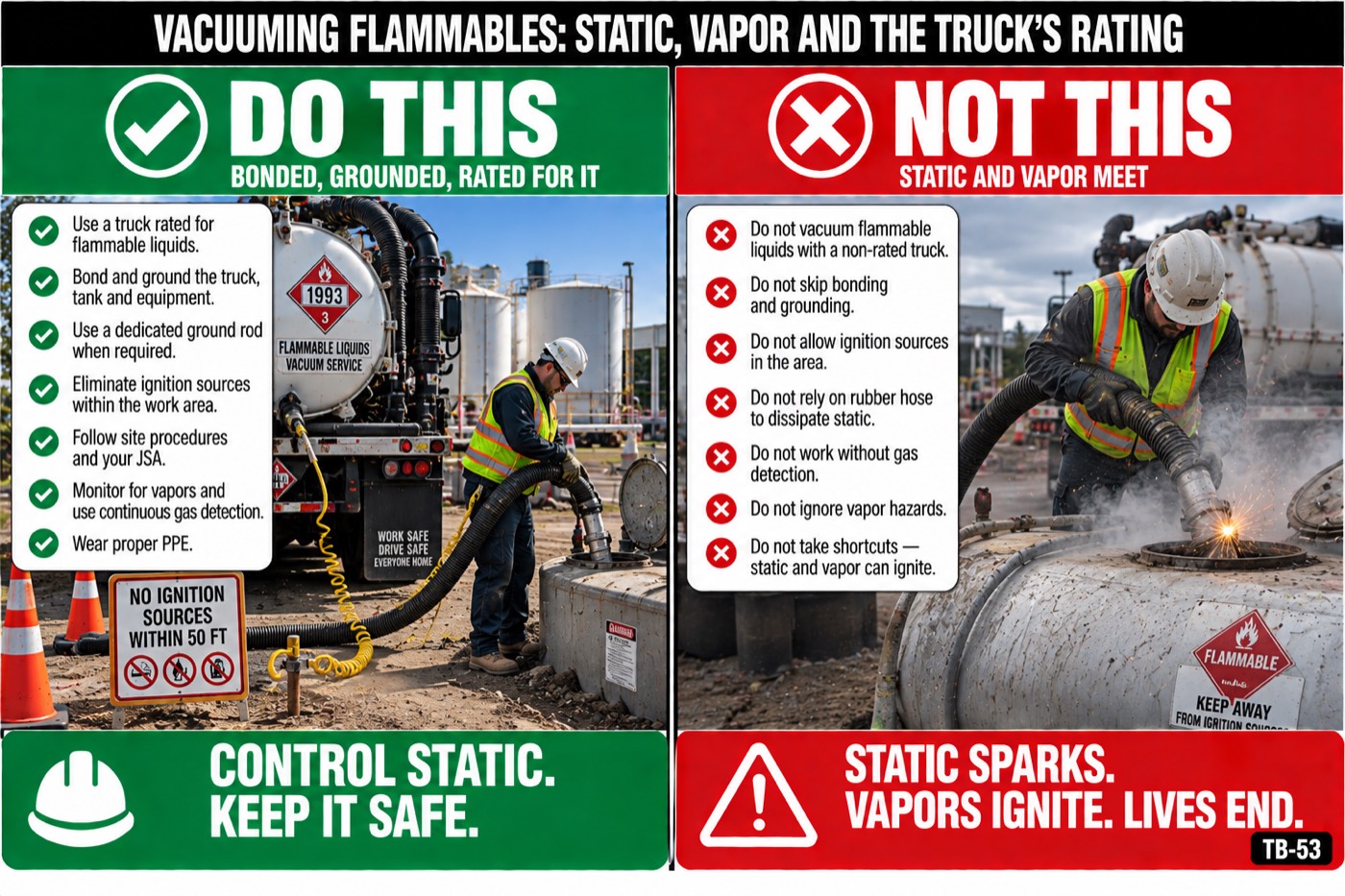
Gasoline vapor burns at a mix of 1.4 to 7.6 percent in air, and liquid moving fast through a plastic hose makes static. A standard vac truck pulling fuel out of a sump is a spark waiting for a mix.
The points
- A flash inside the tank throws the door off and burns whoever is at the hose. A flash at the hose end burns whoever is holding it. Both have happened with ordinary slurry trucks put on a fuel job.
- Transfer of flammable liquids happens only with the containers bonded, under 29 CFR 1926.152, and with no ignition source within 50 feet. The truck and the sump or tank you are pulling from are the two containers.
- A standard hydro-vac is not rated for flammables. If the truck does not have a manufacturer rating for the material, conductive hose, a grounded tank and a blower and exhaust arranged for it, the job goes to a truck that does.
- Bond the truck to the source with a clamp on bare metal, ground the truck with a rod or a proven ground, and use conductive hose with the bond checked with a meter, not by eye.
- The tank vent and the exhaust are ignition sources. Vapor from the tank vent drifting to a hot exhaust, a running generator or a smoker is how the fire starts after the pumping stops.
Why it goes wrong
Static builds when liquid moves through a hose or falls into a tank, and it builds faster with low-conductivity liquids like gasoline, diesel and most solvents. The charge stays on the hose, the nozzle or the truck until it finds a path to ground. A bonding cable gives it that path before the spark does. 29 CFR 1926.152 requires the containers to be electrically interconnected for the transfer of Category 1, 2 and 3 flammable liquids.
Flash point tells you what you are dealing with. Gasoline is about minus 45 degrees; it is making vapor at any temperature you work in. Diesel is over 125 degrees; it does not flash easily until it is heated or sprayed, and a hot slurry tank or a summer tank in the sun heats it. Anything with an unknown flash point gets treated as gasoline.
The truck's rating is not about the vacuum. Trucks built for flammables have grounded conductive hose and tube, a tank and blower arranged so vapor does not pass through the blower or over a hot surface, exhaust routed and often fitted with a spark arrestor, and electrical equipment on the tank rated for the location. A slurry truck's standard exhaust, blower and non-conductive hose are each an ignition source in a vapor cloud.
The vapor is heavier than air and it pools: in the hole, in the sump, in the debris tank, and along the ground on a still day. A meter reading of flammables, the LEL on the four-gas, is part of the test before you start and continuous while you run. 10 percent of the lower explosive limit is the stop point, not 100.
The common mistake is the small job: a few gallons of fuel in a vault, a hydraulic spill, a sump nobody has identified. The person on the hose does not smell it as strongly as they think, the load is mixed with water, and the tank now holds a vapor space nobody planned for. Ask what is in the hole before the hose goes in, and if the answer includes fuel, solvent or anything with a flash point, stop and get the right truck.
Off-loading is the second exposure. The load in the tank keeps making vapor, and the door opening at the dump site or the shop is where the concentrations peak. Same bonding, same 50-foot rule, same meter.
Questions for the crew
- What exactly is in the sump or hole we are pulling from today, and does anyone know its flash point?
- Is this truck rated for that material, and where does it say so?
- Where is the bonding cable, and who checked continuity with a meter?
To close
If today's load has fuel or solvent in it, this truck does not pull it until it is bonded, grounded, metered, and confirmed rated for the material.
To hold this talk with your crew
1
Read it aloud. Five minutes, before the work starts.
2
Ask the questions. A crew that talks is a crew that remembers.
3
Have them sign on their own phones, and the record is sealed.