High-pressure hose: the coupling that lets go
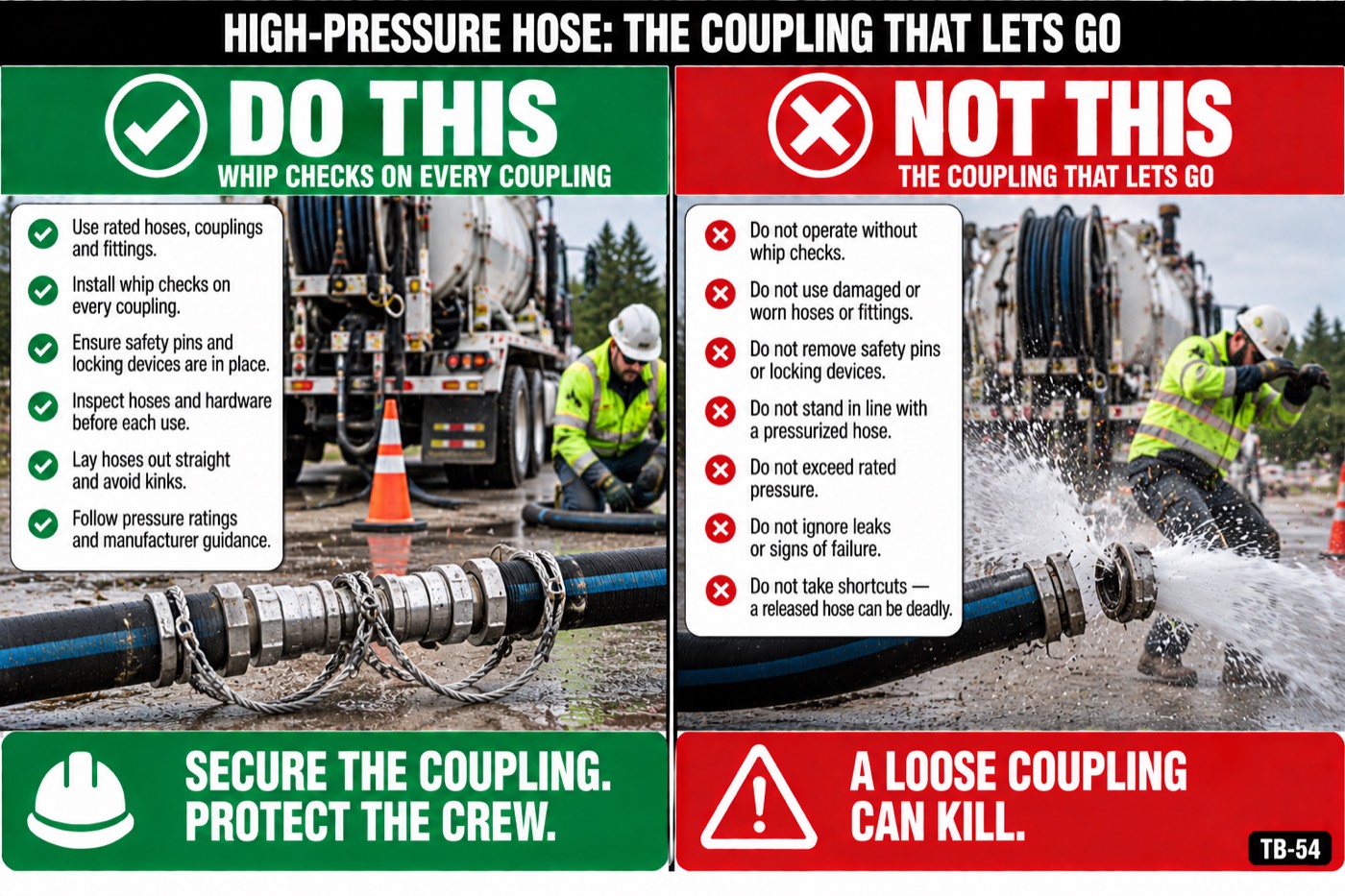
A 3/4-inch water hose at 3,000 PSI has about 1,300 pounds of force pushing on the coupling. When the coupling lets go, that force is what swings the hose end at whoever is nearby.
The points
- A hose end at 3,000 PSI whips at over 100 miles per hour. It breaks arms, takes out teeth and eyes, and the water jet cuts on its way past.
- The rule under 29 CFR 1926.302 is that the manufacturer's safe operating pressure for hoses, valves, pipes and fittings is not exceeded, and that a tool is secured to its hose so it cannot come off. The rating is printed on the hose; if you cannot read it, the hose is out of service.
- A whip check goes across every coupling, both ends, cable anchored to the hose on each side. It does not stop the failure; it stops the hose from swinging.
- Before the pump starts, the whole run is walked: cuts, bulges, kinks, exposed braid, fittings that have been hammered, clamps on a hose that needs crimped ends. Any of those and the hose comes off the job.
- Pressure up slowly with nobody standing over a coupling, and bleed pressure to zero before touching any fitting. A fitting cracked open under pressure is the coupling letting go, on purpose.
Why it goes wrong
Force on a coupling is pressure times the area of the hose bore. A 3/4-inch hose is about 0.44 square inches, so at 3,000 PSI that is roughly 1,300 pounds; a 1-inch hose is about 2,400 pounds. That is the load on the crimp and the threads all day, and it pulses every time the trigger opens and closes. Couplings fail on the pulse, not the steady state.
Hose is rated with a working pressure and a burst pressure, normally a 4-to-1 ratio. A hose marked 3,000 PSI working is expected to burst around 12,000. Running a 2,000 PSI hose on a 3,000 PSI pump eats the whole margin, and the hose that fails is the one somebody grabbed off the shop wall because it fit. Match the hose and the fittings to the pump's relief setting, not to what was handy.
Whip checks are cable restraints with a loop at each end that choke onto the hose on both sides of a coupling. They work only if they are pulled tight so the loops bite, and they are only rated for the hose size stamped on them. A whip check dangling loose on one side of the coupling is decoration. On a hose run, every coupling gets one, including the one at the pump and the one at the wand.
Damage to look for: the outer cover cut through to the braid, a bulge or soft spot, a kink that has been straightened, a fitting that has rotated on the hose, rust or crushed threads on a coupling, a hose that has been run over. Damage at the fitting is the most common because that is where the hose bends. Hose gets stored coiled, not hung on a nail, and gets replaced on the maker's interval or when it fails inspection, whichever comes first.
The common mistake is fixing a leak with tape, a clamp or a tighter pull on the wrench while the pump is running. A leaking fitting is a fitting that is about to fail, and a wrench on a live fitting puts the hand and face right on the coupling when it does. Pump off, pressure bled to zero, then fix it.
The pump relief valve is the last protection in the system and the daily walk-around checks it. If the relief is stuck or set above the hose rating, the hose is the relief.
Questions for the crew
- What is the pressure rating on every hose in today's run, and what is the pump relief set to?
- Which couplings on this truck do not have a whip check right now?
- When did we last take a hose out of service, and why?
To close
Today every coupling has a whip check, every hose has a readable rating above the pump setting, and no fitting gets touched under pressure.
To hold this talk with your crew
1
Read it aloud. Five minutes, before the work starts.
2
Ask the questions. A crew that talks is a crew that remembers.
3
Have them sign on their own phones, and the record is sealed.