Vac truck walk-around: what the driver's signature means
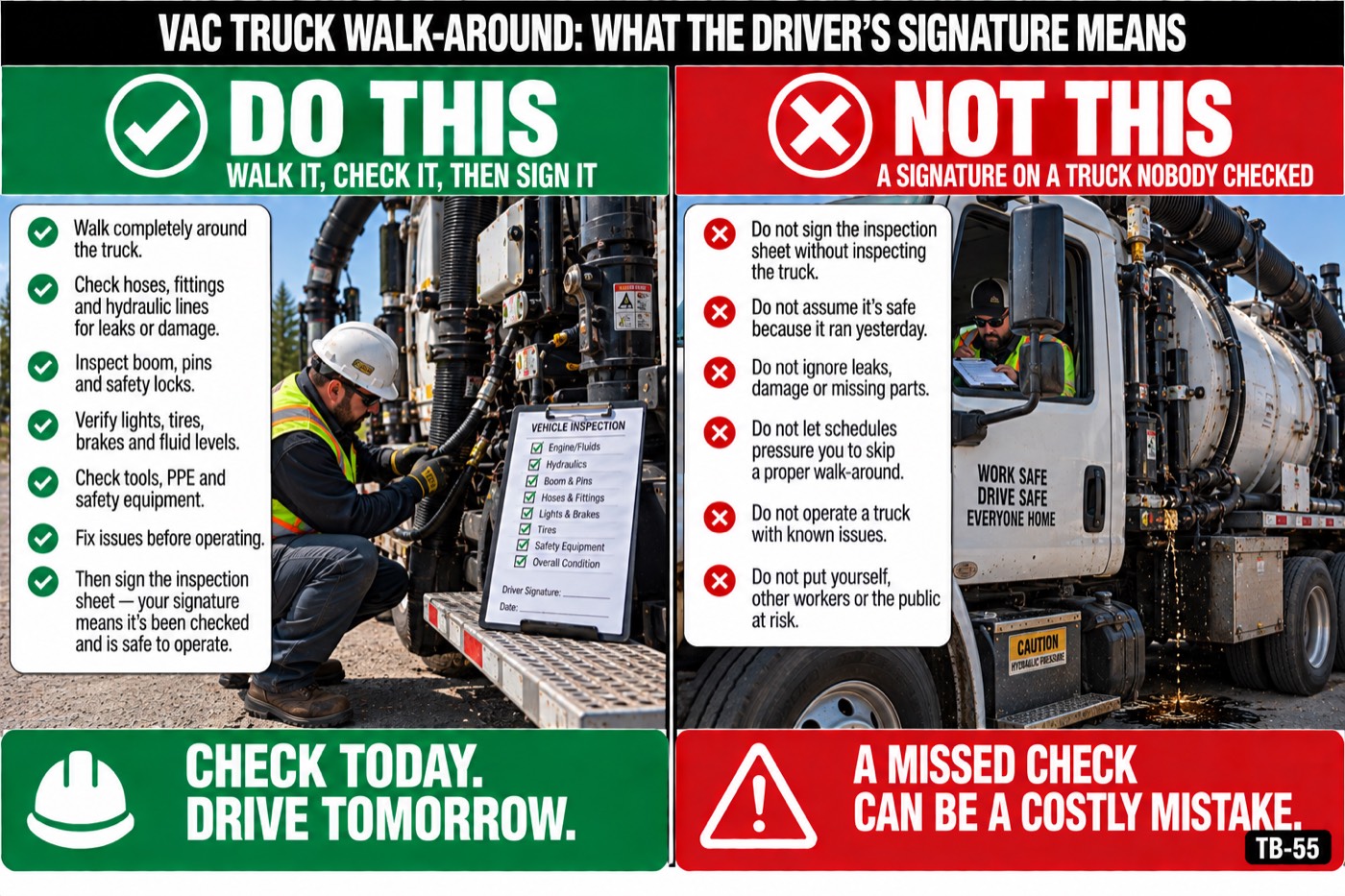
The driver vehicle inspection report has your name at the bottom. When something on this truck fails and hurts someone, that signature is what the investigator reads first.
The points
- A boom that drops, a hydraulic line that bursts at 2,000 PSI, a relief valve that does not open, brakes on a 66,000-pound truck that fade on a hill. Each of those is a walk-around item, and each has killed.
- Under 49 CFR 396.11 the driver inspects at the end of every day, and writes and signs a report for any vehicle with a defect found or reported, and defects get repaired or certified as not needed before the truck moves again. Under 29 CFR 1926.601 the truck also gets checked at the start of each shift.
- The DOT list is brakes, steering, lights, tires, horn, wipers, mirrors, coupling devices, wheels and rims, emergency equipment. The vac truck adds the PTO, boom and hydraulics, tank door and latches, baffles, vacuum and pressure relief, filters and the water system.
- A defect that affects safe operation grounds the truck until it is fixed. Not noted for later, not driven gently to the job.
- The driver signs because the driver is the one who looked. If you did not look at it, do not sign for it.
Why it goes wrong
The signature is a statement that you inspected and that the truck is as reported. When a defect on the sheet is not there and it later hurts someone, the question is why it was not found or why it was not reported. The report protects you when it is honest, and it exposes you when it is not.
PTO and hydraulics run the boom, the tank lift, the door and sometimes the pump. Look for weeping fittings, chafed lines against the frame, a cylinder with a scored rod, a boom that drifts down when parked, a reservoir that is low, which means the fluid went somewhere. Hydraulic fluid at 2,000 to 3,000 PSI escaping through a pinhole is an injection injury from 2 feet away.
The tank has a vacuum relief and a pressure relief. If the vacuum relief sticks, the blower can pull the tank in or overspeed; if the pressure relief sticks, off-loading pressure goes where it wants. The baffles hold the slurry from sloshing; a broken baffle turns a half load into a moving weight that shifts the truck in a turn. Filters and the cyclone or bag house protect the blower; a clogged filter means the blower is starving and running hot.
The water side is a boiler, a pump, a tank and hoses. Water tank levels change the axle weights by 8 to 10 pounds per gallon, so a 1,200-gallon tank is 10,000 pounds moving around above the frame. Check the hose ratings, the relief setting, the boiler fuel and exhaust, and in winter whether the lines were drained.
The common mistake is doing the DOT half well and skipping the truck-specific half because the DVIR form does not list it. Add the vac items to the form. The other mistake is writing no defects from the cab because the truck was fine yesterday. The walk-around is 15 minutes with a light, on your feet, at the truck.
Emergency equipment on a vac truck means the fire extinguisher, the triangles, the four-gas meter and its bump gas, the first aid kit and the eyewash. If the meter is dead, the truck is not ready for a manhole today.
Questions for the crew
- What did this morning's walk-around find, and what is on the sheet from yesterday that is not fixed yet?
- Where are the relief valves on this truck and when were they last proven to open?
- What is the vac-specific list you actually check, and is it written on the form?
To close
Nobody signs the DVIR today for anything they did not put eyes and hands on, and a defect grounds the truck until it is fixed or certified.
To hold this talk with your crew
1
Read it aloud. Five minutes, before the work starts.
2
Ask the questions. A crew that talks is a crew that remembers.
3
Have them sign on their own phones, and the record is sealed.