The walk-around: two minutes before the flat at 65
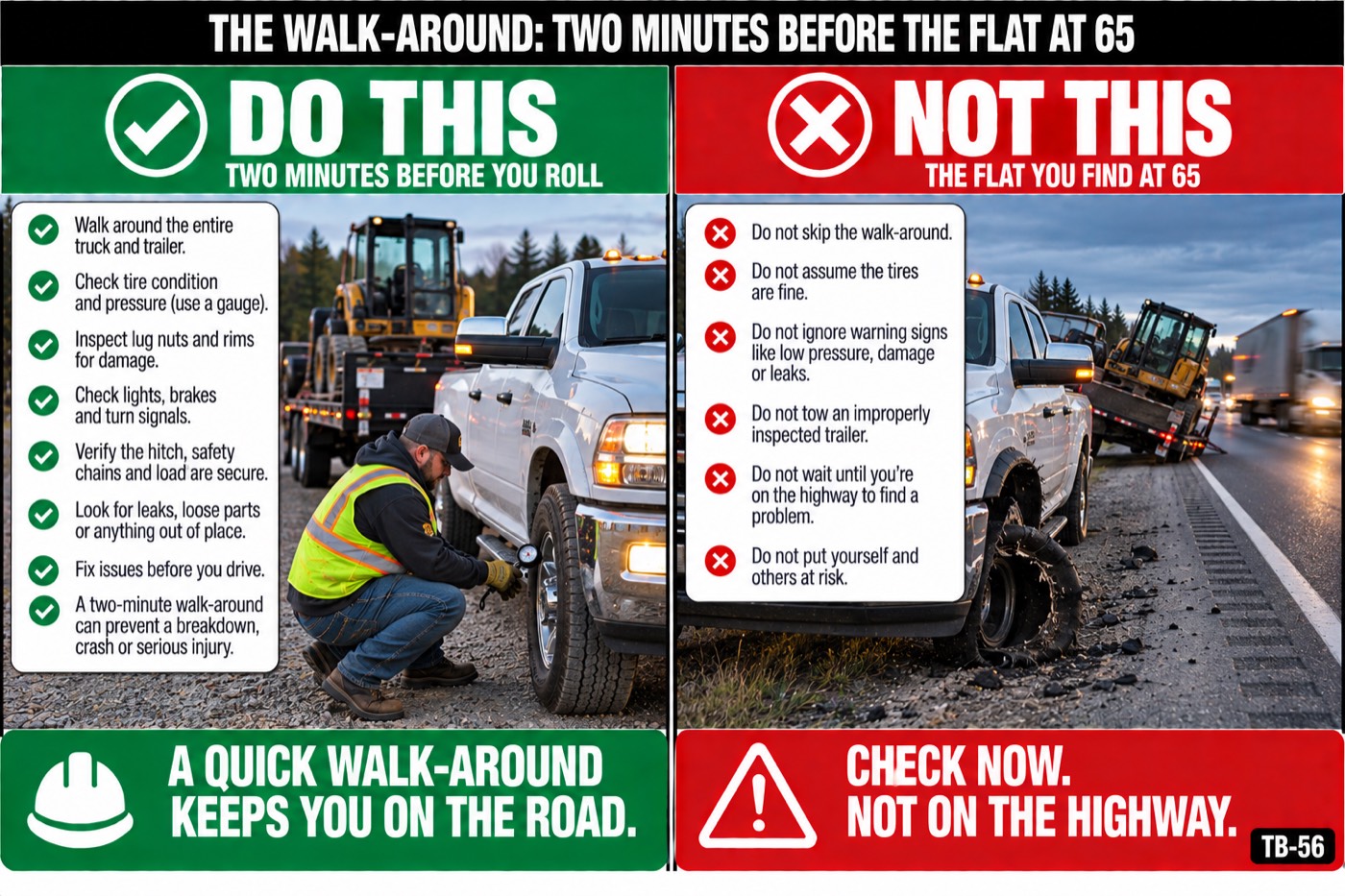
At 65 miles an hour the truck covers 95 feet every second. When a front tire lets go at that speed you get about one second to do the right thing, and the right thing is not what your hands want to do.
The points
- A blowout at highway speed pulls the truck hard toward the dead tire. Drivers who stomp the brake or yank the wheel roll the truck; drivers who hold the wheel straight, stay on the throttle for a beat, and coast down usually walk away.
- Before driving, the driver is responsible for being satisfied the vehicle is safe to drive. That is the DOT rule for anything that is a commercial motor vehicle, and it is the standard good outfits hold every pickup and service truck to.
- Walk all the way around the truck before the first move of the day. Tires for pressure, cuts and bulges, lights and turn signals, the hitch and safety chains if there is a trailer, the load and its straps, the mirrors.
- Light-truck tires run 60 to 80 PSI, not the 35 your car runs. A tire 20 percent low builds heat with every mile and comes apart from the inside; you cannot see 15 PSI by looking at it, so use the gauge.
- Anything you find wrong gets fixed or the truck sits. A soft brake pedal, a bald tire or a dead brake light is a reason to take a different truck, not a note for later.
Why it goes wrong
The walk-around is about two minutes if you do it the same way every time. Start at the driver's door and go one direction around the truck: front left tire, headlights and signals, front right tire, mirror, bed and load, right rear tire, tail lights and brake lights with someone on the pedal, hitch, left rear tire, back to the door. Same loop every morning so nothing gets skipped.
The blowout mechanism is heat. An underinflated tire flexes more in the sidewall on every rotation, and that flexing builds heat until the rubber and cord separate. A tire that was 15 PSI low at the yard can be a tread strip on the shoulder an hour later. Half-ton and three-quarter-ton trucks carrying tools and material every day are running near the tire's rated load all the time, which is exactly when pressure matters most.
When a tire blows, the truck pulls toward that corner and the natural reaction is to brake hard and steer against it. Braking shifts weight forward onto the failed tire and makes the pull worse. The taught response is to grip the wheel firmly, keep steady throttle for a second or two so the truck stays settled, then ease off and let it slow, signal, and work toward the shoulder. Practice the words in your head so your hands know them.
Lights are a two-person check. Someone in the cab works the brake pedal, signals and hazards while someone outside watches. A dead brake light on a truck that stops short on a two-lane is how a rear-end crash happens, and it takes 30 seconds to find.
Mirrors on a service truck get bumped by ladders and by the guy who climbed the side. Set them before you roll, not on the highway. If the load blocks the inside mirror, the outside mirrors are all you have and they need to show the trailer wheels and the lane beside you.
The DOT rule says the driver, not the shop, has to be satisfied the vehicle is safe before driving. OSHA says the same thing about construction vehicles: checked at the start of every shift, brakes, tires, horn, steering, coupling devices, seat belts and lights, and defects corrected before the vehicle goes into service. The person who signs for the truck owns that check.
Questions for the crew
- Who walked around their truck this morning before pulling out, and what did they actually look at?
- What is the tire pressure supposed to be on the truck you are driving today, and when was it last checked with a gauge?
- If the front right tire blows on the way back this afternoon, what do your hands and feet do in the first two seconds?
To close
Every truck that leaves this site today gets walked around first, and anything found wrong is fixed or that truck stays here.
To hold this talk with your crew
1
Read it aloud. Five minutes, before the work starts.
2
Ask the questions. A crew that talks is a crew that remembers.
3
Have them sign on their own phones, and the record is sealed.