Seat belts in the work truck: who gets thrown out
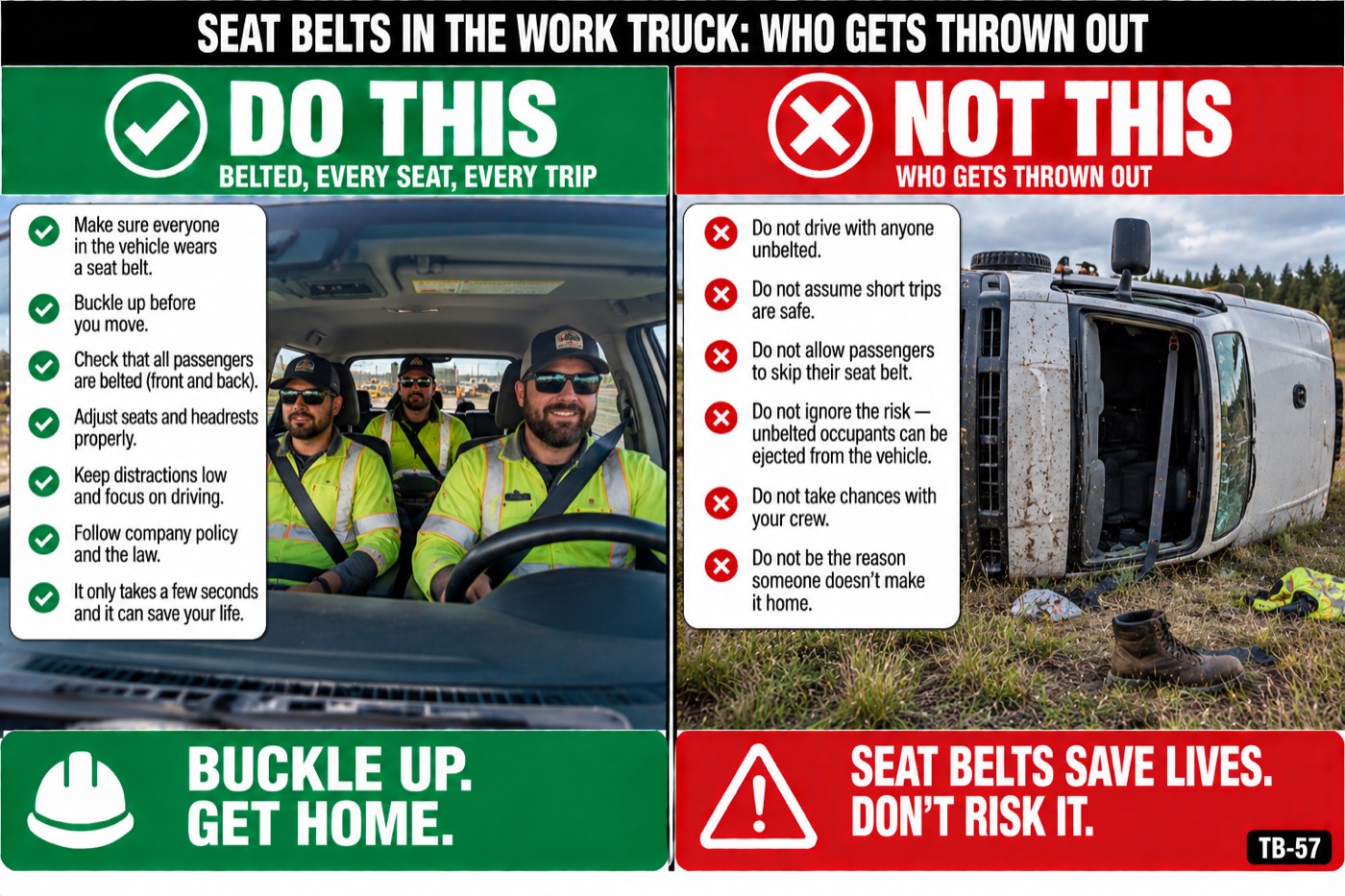
Of the people thrown all the way out of a vehicle in a crash, about three out of four die. Almost nobody wearing a belt gets thrown out.
The points
- Unbelted, the crash happens twice: the truck hits something, then a half second later you hit the windshield, the steering wheel or the pavement at the speed the truck was going. A pickup rolling at 45 puts you through the side window and then under the truck.
- In a commercial motor vehicle, the driver has to be belted and every passenger has to be belted, and the company is not allowed to let the truck move otherwise. Good outfits run that rule on every truck, not just the ones over the CMV line.
- Belted in a pickup, your chance of dying in a crash drops by about 60 percent. That is a bigger number than for cars, because pickups roll over more and a rollover is when ejection happens.
- The belt goes on before the truck moves, every trip, including the 200 yards across the site and the run to the supply house. Many work-truck deaths happen on short, ordinary drives, not on the highway.
- Everybody in the cab is belted or the truck does not move. The driver owns that; a crew member who will not buckle up rides with somebody else, or walks.
Why it goes wrong
Work trucks are heavier and sit higher than cars, and crews feel safe in them. The numbers say otherwise: pickup occupants are less likely to buckle up than car occupants, and pickups are more likely to roll over. Half of the people who die in vehicle crashes in this country were not wearing a belt, and on rural roads, where most of our driving is, the share is higher.
Ejection is the mechanism that kills. In a rollover an unbelted body goes out the window or the door opening on the first or second roll and the vehicle comes over on top of it, or it lands on pavement at 40 or 50 miles an hour. The belt keeps you inside the steel cage that was built to take the hit. Airbags are designed to work with a belt; without one, the bag hits you while you are already flying forward.
The rule for commercial motor vehicles says no driver operates the vehicle unless properly restrained, and no driver operates a property-carrying vehicle unless every other occupant is restrained too. The motor carrier is on the hook for permitting it. Most three-quarter-ton pickups with a trailer are over the 10,001 pound line and are commercial motor vehicles whether the crew thinks of them that way or not.
Properly restrained means the lap belt low across the hips, the shoulder belt across the chest, not tucked under the arm or behind the back. A belt under the arm breaks ribs and lets the upper body fold forward into the dash. A belt with a clip to kill the chime is a belt that is not doing anything.
The crew cab with six people in a five-belt truck is a common one. The sixth rider has no belt and is the one who goes through the windshield. If there are more people than belts, that is two trips or two trucks, not a person on the console.
Short trips are where belts get skipped and where many of the crashes are. A run to the supply house at 35 miles an hour into a car pulling out of a driveway is enough to put an unbelted driver's face into the steering wheel. The habit is: door closes, belt clicks, then the key.
Questions for the crew
- When was the last time you drove somewhere on this job without your belt on, and why did that one feel like it did not count?
- How many belts are in the truck you rode in this morning, and how many people were in it?
- Who on this crew would say something if the driver pulled out with someone unbelted, and what would they say?
To close
Today, no truck on this job moves until everyone in it is belted, and the driver checks before the key turns.
To hold this talk with your crew
1
Read it aloud. Five minutes, before the work starts.
2
Ask the questions. A crew that talks is a crew that remembers.
3
Have them sign on their own phones, and the record is sealed.