Securing the load: the ladder that came off at 60
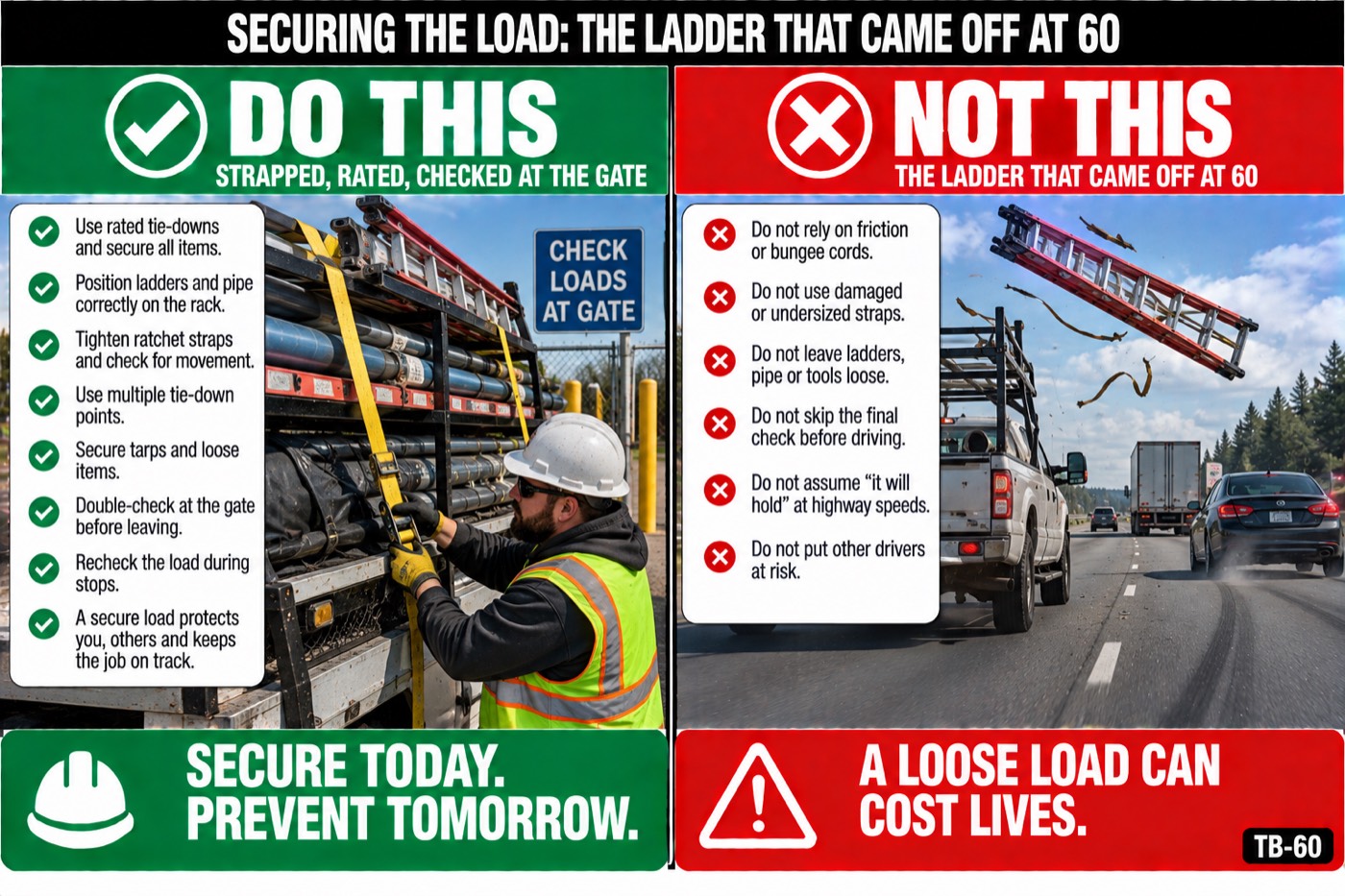
A 28-foot aluminum extension ladder weighs about 65 pounds. Coming off a rack at 60 miles an hour it goes through the windshield of the car behind you, and a bungee cord was what was holding it.
The points
- Cargo that leaves the truck kills the people behind you, and cargo that shifts in a hard stop comes through the back window at you. A 300-pound compressor sliding forward in a 40-mile-an-hour stop hits the cab with several times its weight.
- Cargo must be firmly immobilized or secured with structures, blocking, dunnage or tiedowns of adequate strength. The rule sets a floor: the working load limits of the tiedowns added together are at least half the weight of the load, and there is a minimum count of tiedowns by length.
- Good outfits use a simpler rule: every strap is rated for at least a quarter of the load it holds, and there are at least two on anything, four on anything long or heavy. Read the working load limit on the strap's tag; a 2-inch ratchet strap is typically about 3,300 pounds, a 1-inch strap about 500.
- Ladders and pipe get tied at both ends to the rack, not looped over the middle. Pipe and anything round gets chocked or cradled so it cannot roll. Loose material in an open bed gets a tarp tied down at every corner, because gravel and shingles at 60 are a hail of rocks for the car behind.
- Check the load before you leave, and again in the first few miles. Straps loosen as the load settles, and a strap that was tight at the yard is slack at the first stop sign.
Why it goes wrong
The physics of a hard stop: a truck going 40 that stops in about 75 feet pulls about a 0.7 g deceleration, so every 100 pounds of cargo pushes forward with about 70 pounds of force, and in an actual crash the multiplier is far higher. The tailgate, the headache rack and the back of the cab are what the load hits. That is why the rule wants cargo blocked against forward movement or tied down to hold it, not just kept from bouncing.
The regulation counts tiedowns by length: one tiedown for something 5 feet or shorter and 1,100 pounds or lighter, two for anything up to 10 feet, and one more for every 10 feet or part of it after that. If the load is blocked at the front by a headache rack or bulkhead the count drops to one per 10 feet. Those are minimums, and a strap that is rubbing on a sharp edge counts for nothing.
Working load limit is the number on the tag, usually a third of the strap's breaking strength. The rule adds up the working load limits of the tiedowns and wants the total to be at least half the cargo weight, with a strap that goes over the load and anchors on both sides counting at its full rating. The shop rule of four straps each rated for a quarter of the load gives you twice that floor, and it is easy to do in your head with a 1,200-pound load and 2-inch straps.
Ladders are the item that comes off pickups most. A ladder sits high, catches wind, and a rack with one strap over the middle lets both ends flex until the strap walks off. Tie each end down to the rack and add a cross strap or a locking ladder clamp. Ladders and pipe longer than the bed by more than 4 feet need a red flag in daylight and a red light at night.
Tarps are a load securement item, not a weather item. A load of demolition debris or gravel in an open dump bed loses material at speed and every piece is a projectile for the car behind. Tie the tarp at every ring and check that nothing pokes through. Anything that can blow out, from insulation to empty buckets, gets tied down or goes in the cab.
The first-miles check is what the good drivers do. Loads settle, straps stretch and ratchets work loose on rough roads. Pull off at the first safe place a few miles out, walk around, and pull every strap by hand. The rule says the load has to stay secured for the whole trip, and the crew member who tied it is the person who knows how it should feel.
Questions for the crew
- What is on the truck today, what is it strapped with, and what is the working load limit printed on those straps?
- Which item on the truck would go first in a hard stop, and what is stopping it?
- When did somebody last stop a few miles out to re-check the straps, and what did they find?
To close
Today every strap on every truck gets read for its rating and pulled by hand before the truck leaves, and again at the first stop.
To hold this talk with your crew
1
Read it aloud. Five minutes, before the work starts.
2
Ask the questions. A crew that talks is a crew that remembers.
3
Have them sign on their own phones, and the record is sealed.