Towing a trailer: tongue weight, sway and the chains
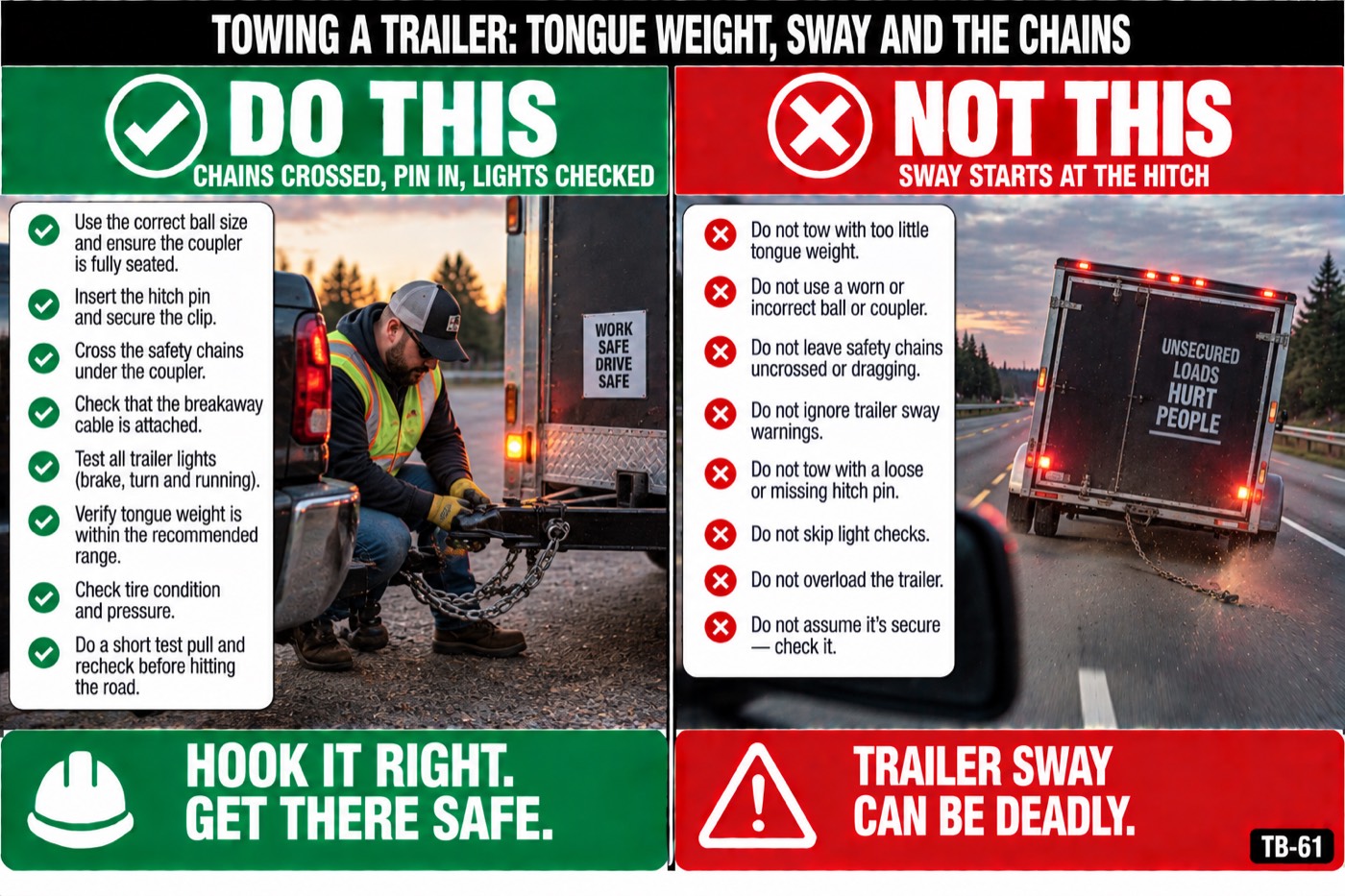
A trailer with too little weight on the tongue starts to sway at about 55 miles an hour, and once it swings past a certain angle the truck cannot pull it straight again. It takes the truck with it into the ditch, or into the oncoming lane.
The points
- Trailer sway kills by rollover or head-on. The trailer starts to fishtail, the driver steers against it, the swing gets bigger each cycle, and inside of five seconds the trailer is pushing the truck sideways. A jackknife or a rollover is the finish.
- Tongue weight is 10 to 15 percent of the loaded trailer weight. A 6,000-pound trailer needs 600 to 900 pounds on the ball, which means the heavy items go forward of the trailer axle. Load it tail-heavy and you have built a pendulum.
- The hitch check is the same every time: ball size matches the coupler, coupler latched and pinned, hitch pin with its clip in the receiver, safety chains crossed under the coupler and hooked to the truck, breakaway cable clipped to the truck and not to a chain, lights and brakes tested.
- The rule for commercial combinations requires safety chains or cables strong enough to hold the full weight of the trailer, attached to the truck's frame or hitch and not to the ball, with no more slack than you need to turn. Crossed chains cradle the tongue if the coupler lets go so it does not dig into the pavement and flip the trailer.
- When a trailer starts to sway, do not brake the truck and do not steer against it. Ease off the throttle, hold the wheel straight, and squeeze the manual lever on the trailer brake controller. The trailer brakes pull the trailer straight behind you.
Why it goes wrong
Sway is a pendulum problem. The trailer pivots on the ball, and if the mass sits behind the axle a gust of wind, a passing semi or a lane change starts it swinging. With proper tongue weight the swing damps out. With light tongue weight each swing is bigger than the last, and the critical speed where that happens drops as the tongue gets lighter. Most sway crashes happen between 55 and 70 miles an hour with a trailer someone loaded tail-heavy to make it easier to hitch.
Getting tongue weight right: heavy items forward of the axle, centered side to side, and tied down so they cannot shift back. A truck that squats hard at the rear with the trailer on has too much tongue weight, which lightens the steer tires; a truck that sits level or nose-down has too little. For a trailer over about 5,000 pounds, a weight-distribution hitch with sway control is what the good outfits run.
The coupler failures come from mismatched balls and unlatched couplers. A 2-inch ball in a 2-5/16-inch coupler looks fine at the yard and lets go on the first big bump. After latching, lift the tongue with the jack a few inches to confirm the coupler is holding the ball, then drop the jack all the way and pin the latch. The receiver pin needs its clip; pins walk out without one.
Safety chains cross under the tongue, right chain to the left hook and left chain to the right hook, hooked with the opening up so a bounce does not unhook them. Crossed, they form a cradle that catches the tongue if the coupler fails. The rule says the chains must have an ultimate strength at least equal to the gross weight of the trailer, attach to the frame and not to the ball mount, and carry only enough slack to turn.
Trailer brakes are required in most states above about 3,000 pounds, and the breakaway switch is what stops a trailer that has separated. Its cable goes to the truck's frame or hitch, never to a chain, because if the chains hold the switch never pulls. Test the controller before you leave: roll forward at walking speed and squeeze the manual lever; you should feel the trailer pull back.
Lights are a two-person check every hookup: running lights, both turn signals, brake lights. A trailer with dead brake lights stopping on a two-lane is invisible to the car behind at night. Carry a spare plug and a test light in the truck, because the plug is the thing that fails.
Questions for the crew
- What does the loaded trailer you are pulling today weigh, and where on the trailer is the heavy stuff?
- Who hitched the trailer this morning, and did anyone lift the tongue to check the coupler was on the ball?
- If that trailer started to sway on the highway this afternoon, what would you do first?
To close
Today nobody pulls out with a trailer until a second person has watched the hitch check and the lights, and the heavy end of the load is in front of the axle.
To hold this talk with your crew
1
Read it aloud. Five minutes, before the work starts.
2
Ask the questions. A crew that talks is a crew that remembers.
3
Have them sign on their own phones, and the record is sealed.