Winter roads: black ice and the drift on the shoulder
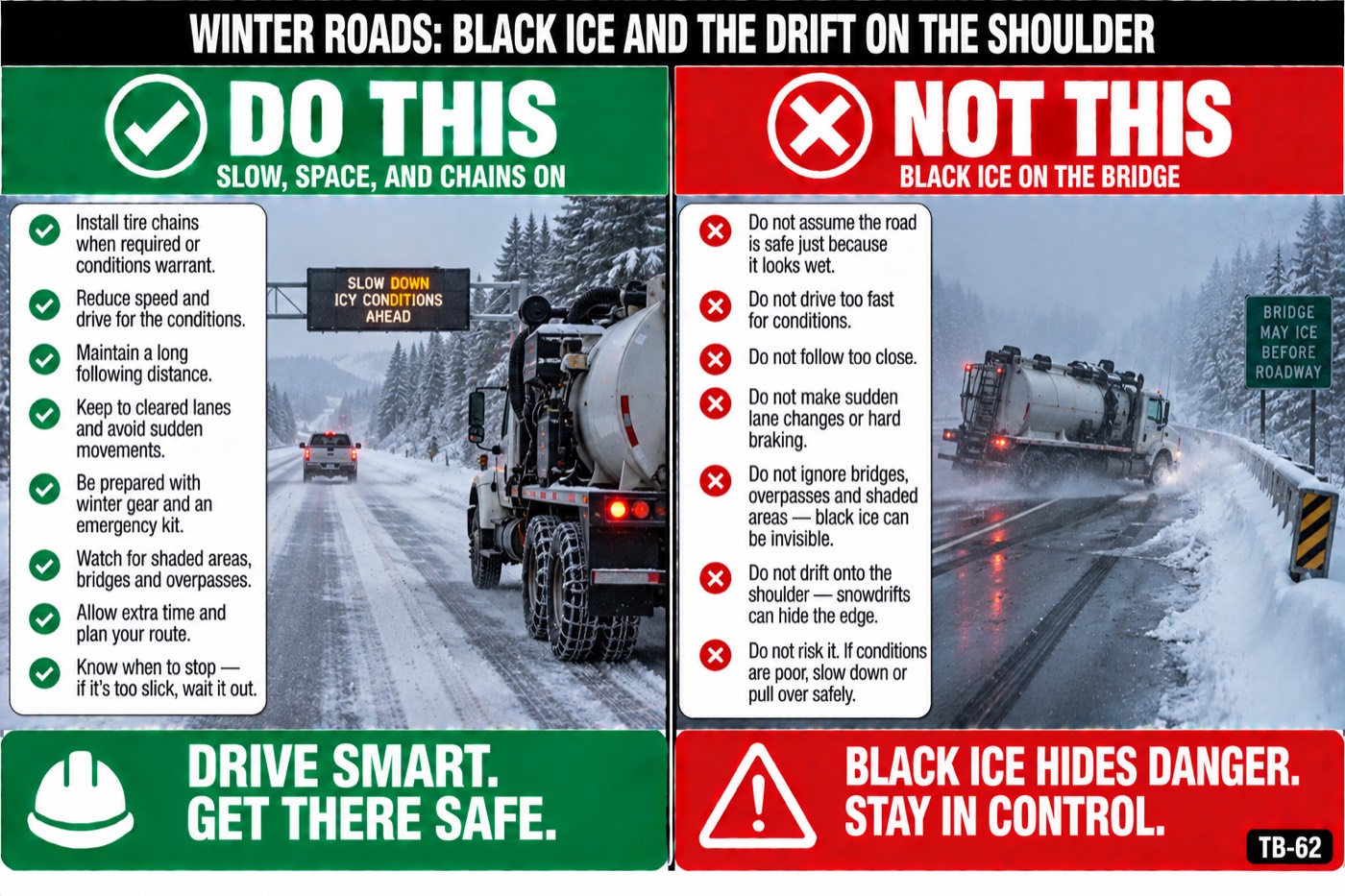
On ice a truck needs up to ten times the distance to stop that it needs on dry pavement. From 45 miles an hour that is the difference between 120 feet and a quarter mile.
The points
- The winter crash is a truck that could not stop or could not turn: into the back of a plow, into the intersection, off the outside of the curve. Four-wheel drive gets you moving on ice; it does nothing to stop you, and it fools drivers into the speed that kills them.
- The rule for commercial motor vehicles says snow, ice, sleet, fog and rain that hurt visibility or traction require extreme caution and reduced speed, and if it gets bad enough the truck stops until it can be driven safely. That is the rule we drive by in every truck.
- Black ice forms first on bridges, overpasses, shaded stretches and anywhere water crosses the road, at air temperatures near 32 degrees, and you cannot see it. If the road looks wet and the spray from the tires stops, you are on ice.
- Following distance goes from 4 seconds to 8 or 10 on snow and ice, and speed comes down until the truck feels planted. Slow inputs only: brake before the curve, not in it, and steer in small moves.
- A drift hides the edge of the road. The plowed lane looks wider than it is, and the white on the right is the shoulder and the ditch under it. Stay in the tracks, and when you pull over, feel for the edge before you commit the wheels.
Why it goes wrong
Stopping distance on ice is a friction problem. Dry pavement gives a tire a grip coefficient around 0.7; packed snow around 0.3; ice near freezing as low as 0.1. Braking distance scales with the inverse of that number, so the same truck that stops from 45 in about 120 feet on dry asphalt needs 300 feet on packed snow and can need 800 feet or more on wet ice. Loaded trucks and trailers make it worse.
Black ice is a thin, clear layer that shows the black pavement through it. It forms when the road surface is at or below 32 degrees and water from melt, spray, fog or a culvert freezes on it. Bridges freeze first because cold air reaches them from below. The tells are a wet-looking road without spray, the sudden quiet of the tires, and a steering wheel that goes light. If you feel it, ease off the throttle and hold the wheel straight; do not brake until you feel grip again.
Four-wheel drive splits engine power to all four tires, which helps you accelerate on a slick surface. Brakes already work on all four wheels in every truck, so four-wheel drive adds nothing to stopping, and it does nothing for cornering. The trucks in the ditch on a snowy morning are disproportionately four-wheel drives, because the drivers went the speed the acceleration told them was fine.
Chains and traction devices are required by law on some mountain routes when the signs go up, and the fine for ignoring the sign is the small consequence. Carry the right size chains for the drive tires, practice putting them on in the yard once in dry weather, and put them on before you need them, on a pullout, not on the grade. Drive under 30 with chains on.
The drift that hides the shoulder is a rural two-lane problem. Wind fills the ditch level with the road and the plow leaves a lane narrower than it looks, with the drift on the right looking like usable road. A truck that puts its right wheels into it drops a foot or two and rolls toward the ditch, and with a trailer it goes over. Stay in the wheel tracks, slow down where drifts cross, and if you must stop, stop where the edge is visible.
The rule says discontinue the operation when conditions become sufficiently dangerous. That is a call for the driver and the foreman, and the wrong answer is to push through because the job is waiting. A crew that waits three hours for the plow and the sun is a crew that shows up. Check the road report before leaving and have a plan for where the truck stops if it gets worse.
Questions for the crew
- Which stretch of the drive to this site freezes first, and who has felt the truck go light there?
- How much following distance did you actually leave behind the last vehicle this morning, and how many seconds is that?
- Where would you stop this truck and trailer safely on that road if the snow got worse, and who decides to stop?
To close
Today every driver doubles their following distance, brakes before every curve and not in it, and calls the foreman before the road gets bad rather than after.
To hold this talk with your crew
1
Read it aloud. Five minutes, before the work starts.
2
Ask the questions. A crew that talks is a crew that remembers.
3
Have them sign on their own phones, and the record is sealed.