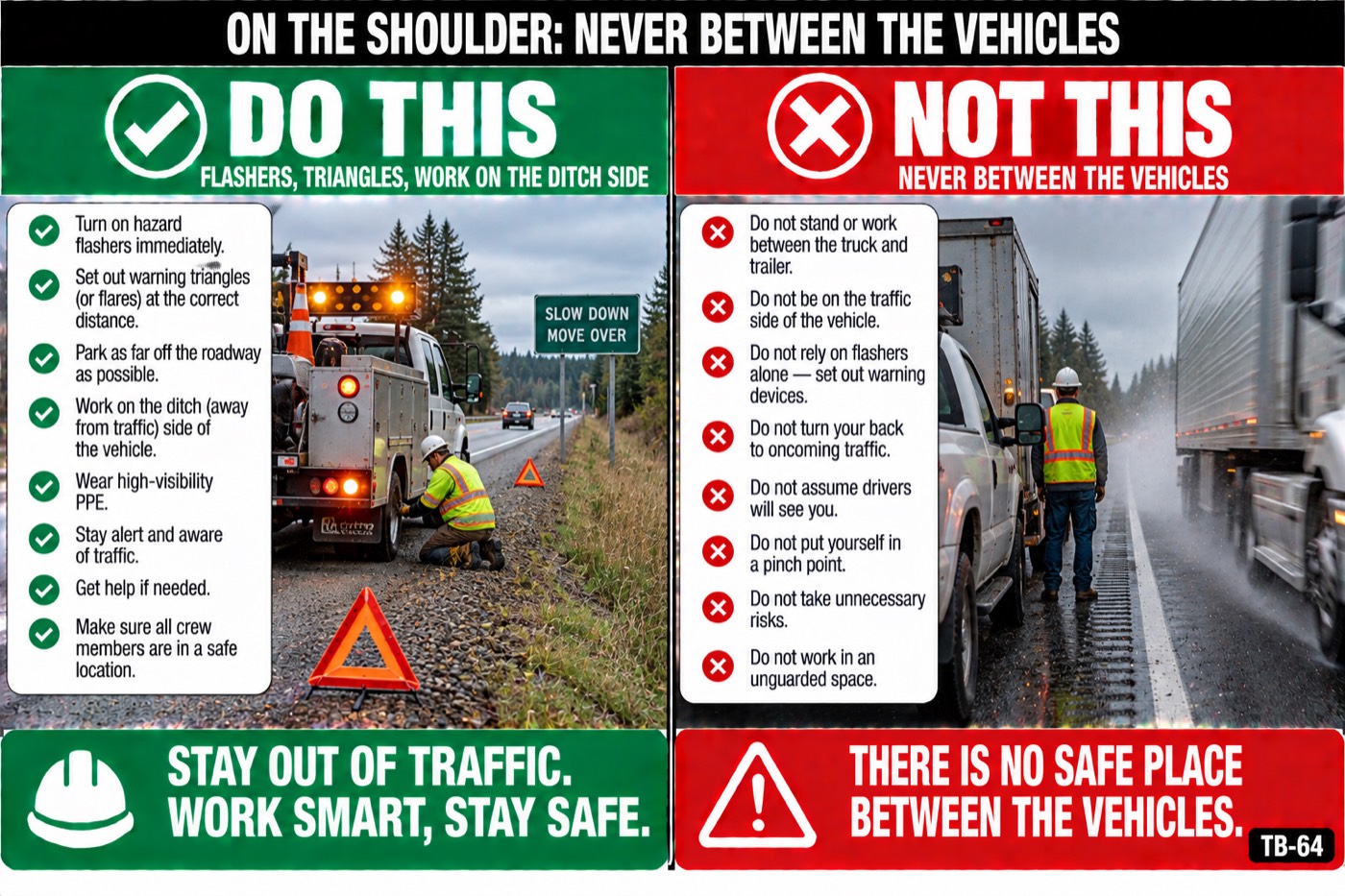
On the shoulder: never between the vehicles
A car at 65 miles an hour closes 95 feet every second. A driver looking at a phone for three seconds covers 285 feet, which is the whole length of the shoulder you are standing on.
The points
- The person killed at the roadside is the one changing a tire, hooking a chain or reading a load sheet with their back to traffic. They are hit by a drifting car at full speed, or crushed when the car hits the parked truck and the truck is shoved into them.
- For a stopped commercial motor vehicle the rule is hazard flashers on immediately, and warning triangles out within 10 minutes: one 10 feet behind on the traffic side, one 100 feet behind in the lane or shoulder, and one 100 feet ahead. Every truck we run carries the triangles and uses them.
- Get all the way off the road, past the white line by as much as the ground allows. A flat tire at 65 is driven at walking speed on the rim to the next exit or wide pullout rather than changed 18 inches from a lane.
- Out of the truck on the side away from traffic, high-vis vest on before your feet hit the ground, wheels turned away from the road so a struck truck rolls off, not into you, and an escape route in your head: where you go when you hear tires on gravel.
- Never stand between two vehicles, and never between a vehicle and traffic. If a truck must hook to a trailer or a stuck vehicle on the shoulder, the hookup is done by a single crew member at a time and everyone else is behind the guardrail or well off the road.
Why it goes wrong
Roadside deaths are a physics problem with a person in the middle. A car that drifts 3 feet over the white line at 65 does not slow down; the driver is asleep, drunk or on a phone and never brakes. A pickup parked on the shoulder that is hit from behind moves forward 20 or 30 feet, and anyone in front of it or between it and a trailer is under it. That is why the two rules are: get farther off the road than feels necessary, and never put your body between steel and traffic.
Every state has a move-over law that requires drivers to change lanes or slow down for stopped emergency and work vehicles with lights on, and many now include any vehicle with hazards on. Do not count on it. Amber lights and flashers get you a lane change from perhaps half the drivers. The triangles at 100 feet buy the other half a second or two to react, and that is why the rule wants them out fast.
The exit side matters. Sliding across to the passenger door and getting out on the ditch side keeps the truck between you and traffic. If you have to work on the traffic side, face traffic while you do it so you see what is coming, and keep the work short. A tire change on the traffic side of a truck on a two-lane with no shoulder is a tow-truck job, not a crew job.
Wheels turned away from the road is a cheap habit that has saved lives. A struck truck with the wheels straight goes straight ahead down the shoulder; with the wheels turned right it veers into the ditch, away from the person working in front of it. Parking brake on, and chocks if there is any grade. Never leave the truck in gear as the only thing holding it.
The escape route is decided before you start working. Look at where the guardrail, the ditch, the fence is, and know that if you hear a horn, gravel, or a skid you go there without looking first. Crews who look first take a second to decide, and a second is 95 feet of car. Keep the phone in your pocket on the shoulder; the load sheet can be read in the cab.
High-visibility vests are required for workers on foot in a highway right-of-way, and at night the vest needs reflective bands, which is the Class 2 or Class 3 vest in the truck door, not the faded one under the seat. Flashers on every truck that stops, amber beacon if it has one, and the vest goes on before the door opens. It takes ten seconds and it is the only thing a drifting driver can see.
Questions for the crew
- If this truck got a flat on the road out here, where is the next place you could get all the way off, and how far is it?
- Where are the warning triangles in the truck you are driving today, and when did you last set them out?
- The last time someone on this crew worked on the shoulder, which side of the truck were they on and where was the escape route?
To close
Today nobody works on a road shoulder without the vest on, the triangles out, the wheels turned away and a way out they have already picked.
To hold this talk with your crew
1
Read it aloud. Five minutes, before the work starts.
2
Ask the questions. A crew that talks is a crew that remembers.
3
Have them sign on their own phones, and the record is sealed.