Rural two-lanes: the pass that ends head-on
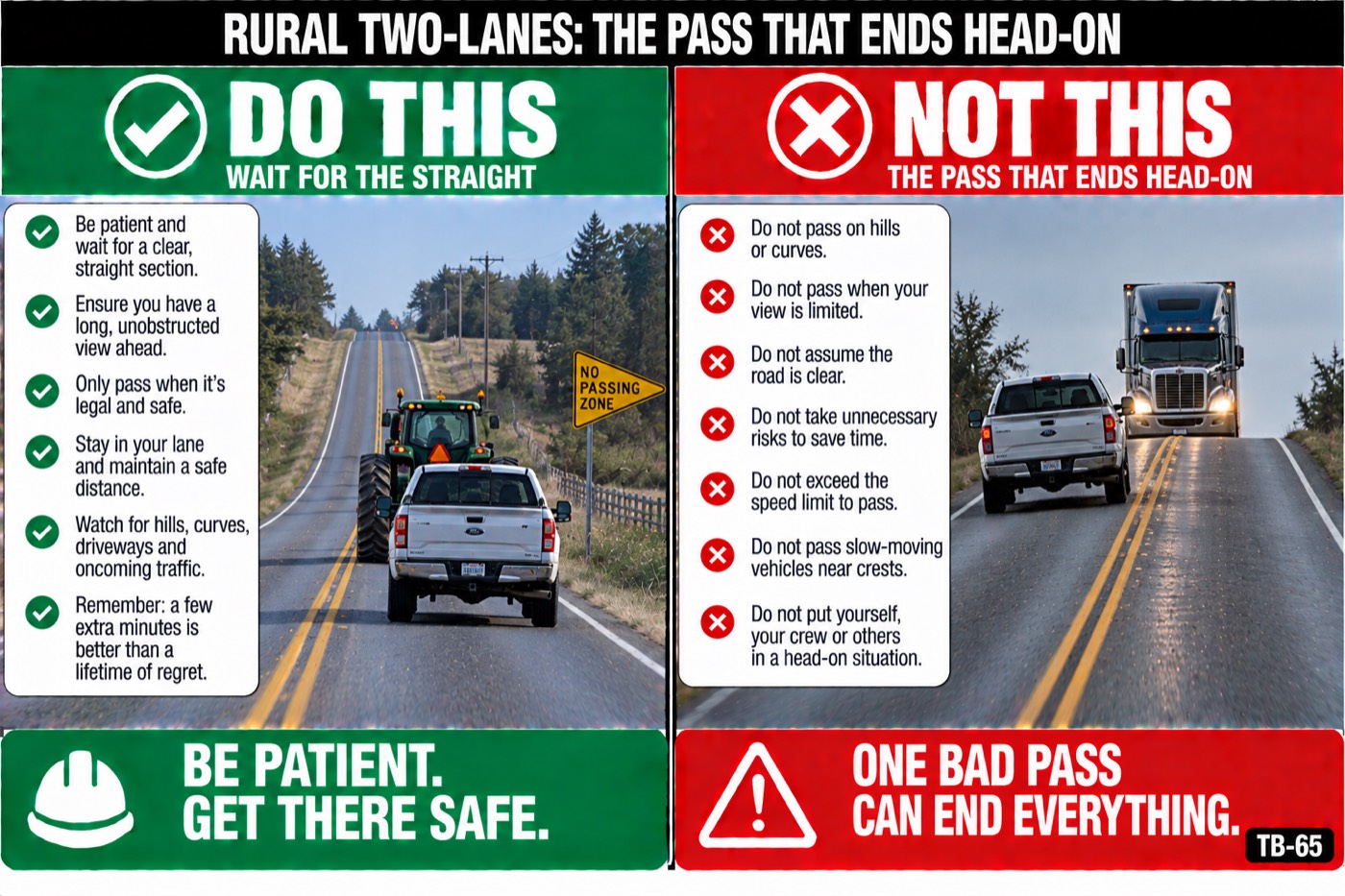
Two pickups meeting head-on at 55 each hit at a closing speed of 110 miles an hour. Rural roads carry a fraction of the country's miles and close to half of its traffic deaths, and the head-on from a pass is the one that kills the most people at once.
The points
- The rural crash is a head-on or a run-off-road at speed. There is no median, the shoulder is soft or missing, the trees are 10 feet from the pavement, and the ambulance is 40 minutes out.
- Passing on a two-lane takes about 10 seconds at highway speed, and in those 10 seconds an oncoming car covers 800 feet while you cover 800 feet. You need close to a third of a mile of clear road, and a hill or a curve hides that much easily.
- The rule for commercial motor vehicles says a company cannot schedule a run so tight that the truck has to speed to make it. That is the standard here: nobody on this crew is late enough to pass on a hill.
- A loaded truck or a truck pulling a trailer does not pass. It accelerates slower, stops longer and the trailer wants to sway at the speed a pass needs. Sit behind the tractor at 40 and lose three minutes.
- Speed on a two-lane is set by what you can see, not the sign. If you cannot stop within the road you can see ahead, you are going too fast for a stalled combine around the bend.
Why it goes wrong
Head-on crashes are worse than any other type because the energy of both vehicles goes into the same 4 feet of steel. Airbags and belts are designed around a 35-mile-an-hour barrier crash; a 55-on-55 head-on is far beyond that. Rural roads have a fatality rate per mile driven about one and a half times that of urban roads, and speed, no belt, and a long wait for medical care are the three reasons.
The passing math: to pass a vehicle doing 45 while you do 60 you need to cover the vehicle's length plus a safe gap ahead and behind, about 200 feet of relative distance, at a closing speed of 15 miles an hour, which is 22 feet per second. That is 9 or 10 seconds in the oncoming lane. An oncoming car at 60 covers 880 feet in those 10 seconds. Add your own 880 feet and you need 1,760 feet, a third of a mile, of clear, visible road with no driveways.
The pass that kills is the one where the driver has been stuck behind a slow vehicle for miles and commits on a short straight, then a car appears over the crest. The driver has three bad choices: floor it and hope, brake and duck back into a gap that may not be there, or take the shoulder. Nobody makes a good decision in the 2 seconds that leaves. The decision is made before the pass: if it is not a long straight with nothing coming, it is not a pass.
The speed limit is a maximum for a dry road with good sight lines. Rural two-lanes have blind crests, farm equipment doing 20, deer at dusk, and gravel on the curves. The working rule is that you can stop within the distance you can see, and on a curve with trees that might be 300 feet, which at 55 is about your stopping distance with no margin.
Run-off-road is the other rural killer. A driver drifts onto a soft shoulder, feels the drop, yanks the wheel back and the truck crosses the road or rolls. The recovery is: ease off the throttle, keep the wheel straight, let the truck slow on the shoulder, and steer back onto the pavement gently at a low speed. Two wheels on the gravel is not an emergency; the jerk back is.
The company side of the rule is real. A crew told to be on site at 7 with a 90-minute drive on a two-lane that leaves at 5:45 is a crew being scheduled to speed. The regulation puts that on the carrier, not the driver. If the schedule needs 70 on a road posted 55, the schedule is wrong and the foreman changes it.
Questions for the crew
- On the road to this site, where is the stretch where people pass, and how much of it can you actually see?
- What is behind the truck today, and does that change whether you would pass a slow vehicle?
- Has anyone on this crew ever started a pass and had to abort it, and what did they do?
To close
Today nobody passes on the two-lane unless there is a third of a mile of clear road they can see, and nobody pulling a trailer passes at all.
To hold this talk with your crew
1
Read it aloud. Five minutes, before the work starts.
2
Ask the questions. A crew that talks is a crew that remembers.
3
Have them sign on their own phones, and the record is sealed.