Hauling the machine: four binders and a ramp that slides
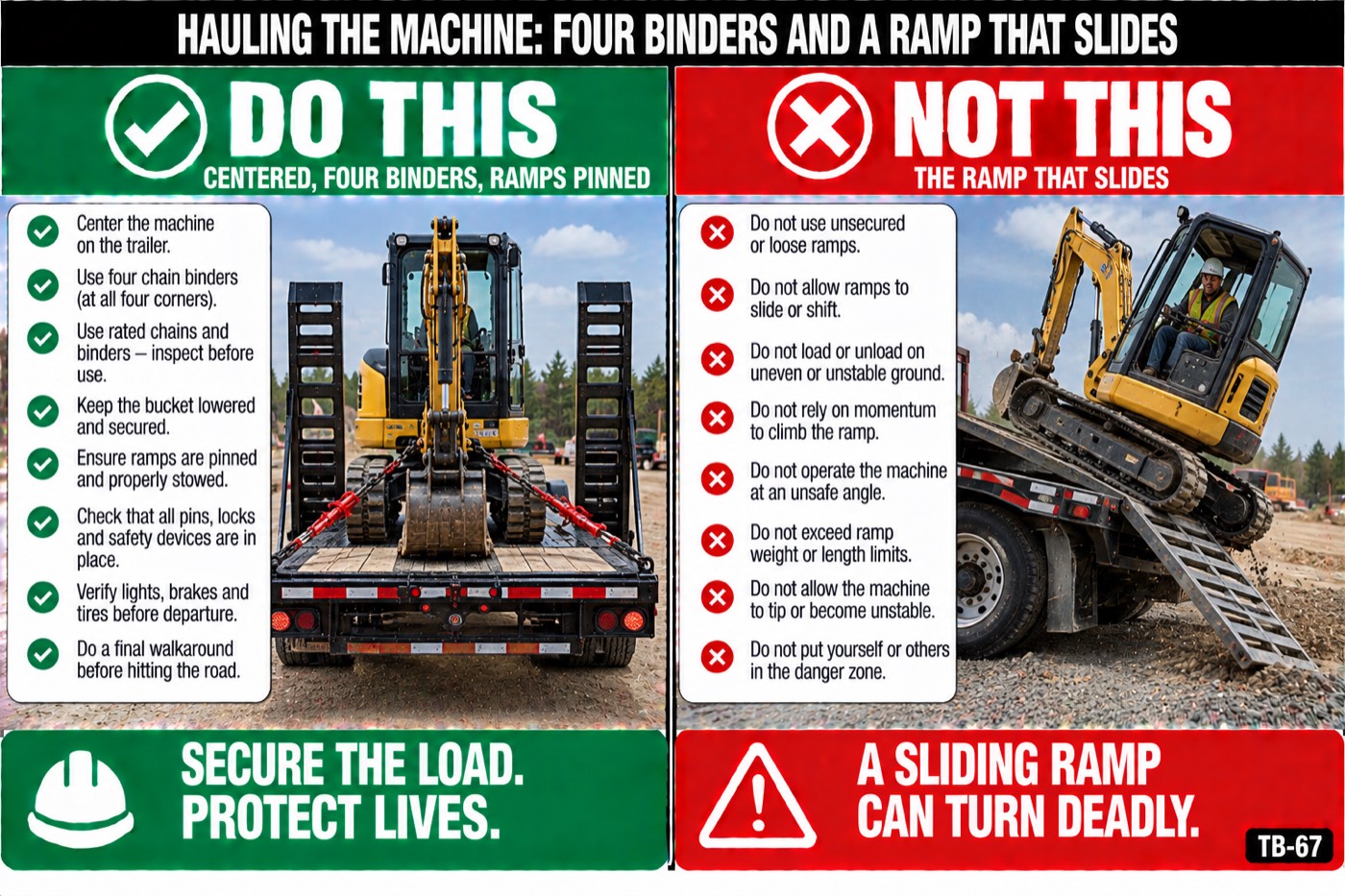
A skid steer weighs about 8,000 pounds and a mini excavator about 10,000. Coming off a trailer on the highway, either one goes through anything it hits, and a loose ramp under the tracks drops the machine and whoever is standing beside it in the same second.
The points
- Machines kill on the trailer three ways: they roll or tip off the ramps during loading, they shift on the highway and take the trailer over, or the binders let go and the machine leaves the trailer. Every one of those starts with a step someone skipped in the yard.
- For a machine of 10,000 pounds or more the rule requires at least four tiedowns, as close to the front and rear of the machine as practical, and every attachment lowered and secured. Good outfits run four on everything with tracks or wheels, whatever it weighs.
- Load it straight and centered: ramps pinned and level with each other, the machine's heavy end uphill and slow, a spotter clear of the ramps and never below the machine. Set it so about 60 percent of the weight is forward of the trailer axles.
- Chains and binders are rated equipment. Grade 70 transport chain in 3/8 inch has a working load limit of 6,600 pounds, 5/16 inch about 4,700. The chain hooks through the machine's tie-down points, not around a hydraulic cylinder or the bucket, and the binder handle gets locked or tied off.
- Before the truck moves: bucket down, controls locked, machine off, keys out. Stop in the first few miles and put a hand on every chain, because a machine settling on its tires or tracks loosens what was tight.
Why it goes wrong
The loading tip-over is the one that kills operators. A tracked machine going up a ramp at an angle, a wheeled machine turning on the ramp, or a ramp that shifts under one track drops the machine off the side of the trailer. Ramps must be pinned or chained to the trailer, set at the machine's track width, and on ground firm enough that the trailer does not settle on one side. The operator goes up slow, straight, and belted, and the spotter stands at the front of the trailer in the operator's view, never beside the ramps.
Heavy end uphill: a skid steer with a loaded bucket or an excavator with the house forward has most of its weight at one end, and driving the light end up first tips it backward on the ramp. Skid steers back up onto the trailer; mini excavators go up boom-forward with the boom low so the weight stays over the tracks. Stop before the ramp and think about where the weight is.
Centering the load side to side and getting about 60 percent of the weight forward of the axles keeps the trailer stable and keeps enough tongue weight on the truck. A machine parked at the back of a tandem trailer takes the weight off the truck's rear tires and the combination sways at 50. Once positioned, the parking brake goes on, the bucket or blade goes down onto the deck, and the controls are locked.
The rule for heavy vehicles and equipment says a minimum of four tiedowns, front and rear, each of them rated, with the aggregate working load limit at least half the weight of the machine. A chain that runs from the trailer to a tie-down point on the machine counts at half its rating, so four 3/8-inch grade 70 chains count as 13,200 pounds. That covers a machine up to 26,400 pounds. Chains go to the machine's tie-down points, the binders are rated to match the chain, and each chain runs at an angle that resists forward, backward and sideways movement.
Binder handles are a hand injury and a securement failure. A lever binder stores enough energy to break a wrist when it releases, and it can unhook itself on a rough road. Ratchet binders take longer and stay tight. Whichever you use, the handle gets locked or tied off, and the binders are on the side away from traffic so the re-check does not put you in the lane.
Width and height are a permit question before they are a driving question. Most states allow 8 feet 6 inches wide and 13 feet 6 inches tall without a permit; a machine with a wide bucket or a raised boom goes over one or both. Measure it before you leave the yard, get the permit if it needs one, and know the route's bridge heights. The boom that hits an overpass at 55 takes the machine, the trailer and the truck.
Questions for the crew
- What machine is going on the trailer today, what does it weigh, and where will the four chains hook to it?
- Who is spotting the load, and where exactly will they stand while it goes up the ramps?
- How wide and how tall is that machine on the trailer, and does the route have a bridge lower than that?
To close
Today no machine leaves on a trailer without four rated chains on its tie-down points, the bucket down and locked, and a hand on every binder a few miles out.
To hold this talk with your crew
1
Read it aloud. Five minutes, before the work starts.
2
Ask the questions. A crew that talks is a crew that remembers.
3
Have them sign on their own phones, and the record is sealed.