Formwork: stripped too early is a collapse
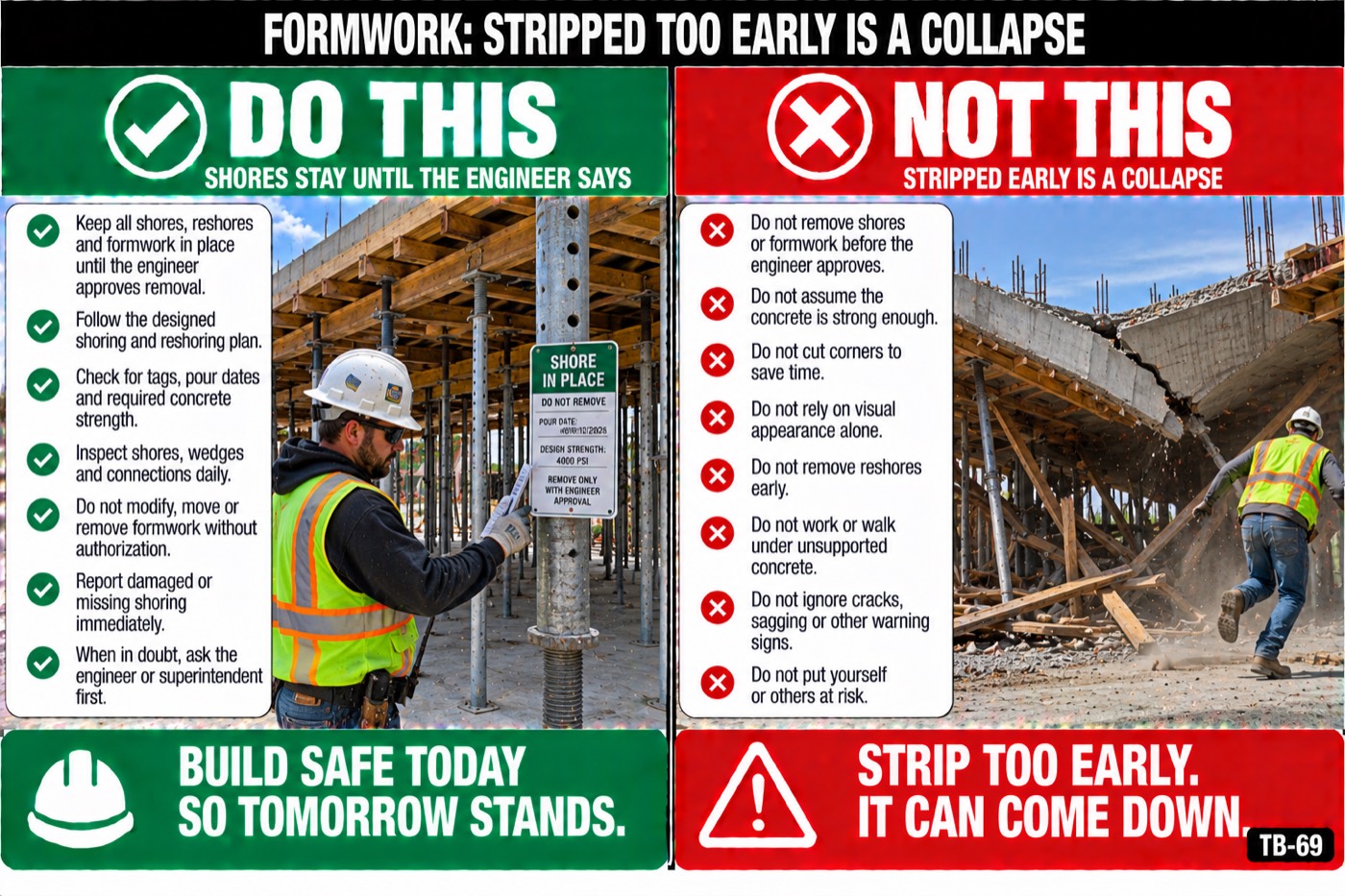
Fresh concrete weighs about 150 pounds a cubic foot. A wall form 8 feet high is holding back about 1,200 pounds on every square foot at the bottom, and the concrete is a liquid until it sets.
The points
- When formwork lets go, the concrete comes out and the crew on the deck goes down with it. Forms blowing out during the pour and shores pulled too early are how most cast-in-place collapses happen.
- Forms and shores have to carry every load that will be on them: the wet concrete, the crew, the pump hose, the buggy, and the vibrator pushing the concrete into the corners.
- Shoring gets inspected before you erect it, and immediately before, during and after the pour. A bent shore, a missing pin, or a base plate sitting on soft dirt does not go under a pour.
- Nobody pulls a form or a shore until the concrete has the strength to hold itself up. That comes from the plans and specs or from a cylinder break, not from tapping the slab with a hammer.
- Reshores go in as the forms come out when the slab cannot carry its own weight yet, and they stay in until the concrete tests out.
Why it goes wrong
Fluid concrete pushes sideways on a wall form at roughly 150 pounds per square foot for every foot of depth above that point. An 8-foot pour is about 1,200 pounds per square foot at the bottom. The ties and walers are set for a pour rate and a temperature. Pouring faster than the form was designed for, or pouring in cold weather where the bottom does not stiffen, is how a wall form blows out.
A 6-inch slab weighs about 75 pounds a square foot before anyone walks on it. Add the rebar, the crew, a loaded buggy and the impact of dumping, and the shores under the deck carry it all. Shores on mud sink during the pour. Shores on frozen ground are fine until the afternoon it thaws. Mud sills spread the load, and base plates have to bear on something firm.
Concrete gains strength with time and temperature. At 70 degrees it might reach around 70 percent of its 28-day strength in 7 days. At 40 degrees it can be half that. So the only things that decide when to strip are the conditions written in the plans and specs, or a test on cylinders cured with the slab. The classic collapse is shores pulled on day 3 because the next floor needed them.
29 CFR 1926.703 puts the inspections at four points: before erection, immediately before, during and after the pour. It says single post shores stacked on top of each other need an engineered design and diagonal bracing at the splice. And it says forms and shores come off only when the concrete has the strength to support its loads, shown by the plans or an ASTM strength test.
The shore that gets pulled in the middle is the quiet killer. Someone needs a shore for something else and takes one. The load it carried goes to the shores around it, which nobody designed for that. Then a second one goes. No shore comes out unless the person running the formwork has said so, and that person knows what it was carrying.
During the pour, somebody watches the forms, not the concrete. Bulging, a tie snapping, a shore leaning, water squirting out of a joint. Any of those stops the pour until it is fixed, and everyone on the deck knows the signal to stop the pump and get off.
Questions for the crew
- Who checked the shores under this deck this morning, and what pour rate are these forms set for?
- What would you do if a form started to bulge in the middle of the pour?
- When do we strip this, and what is that date based on?
To close
Nothing gets stripped and no shore gets pulled today unless the person running the formwork has said the concrete is ready.
To hold this talk with your crew
1
Read it aloud. Five minutes, before the work starts.
2
Ask the questions. A crew that talks is a crew that remembers.
3
Have them sign on their own phones, and the record is sealed.