Pinch points and where hands get caught
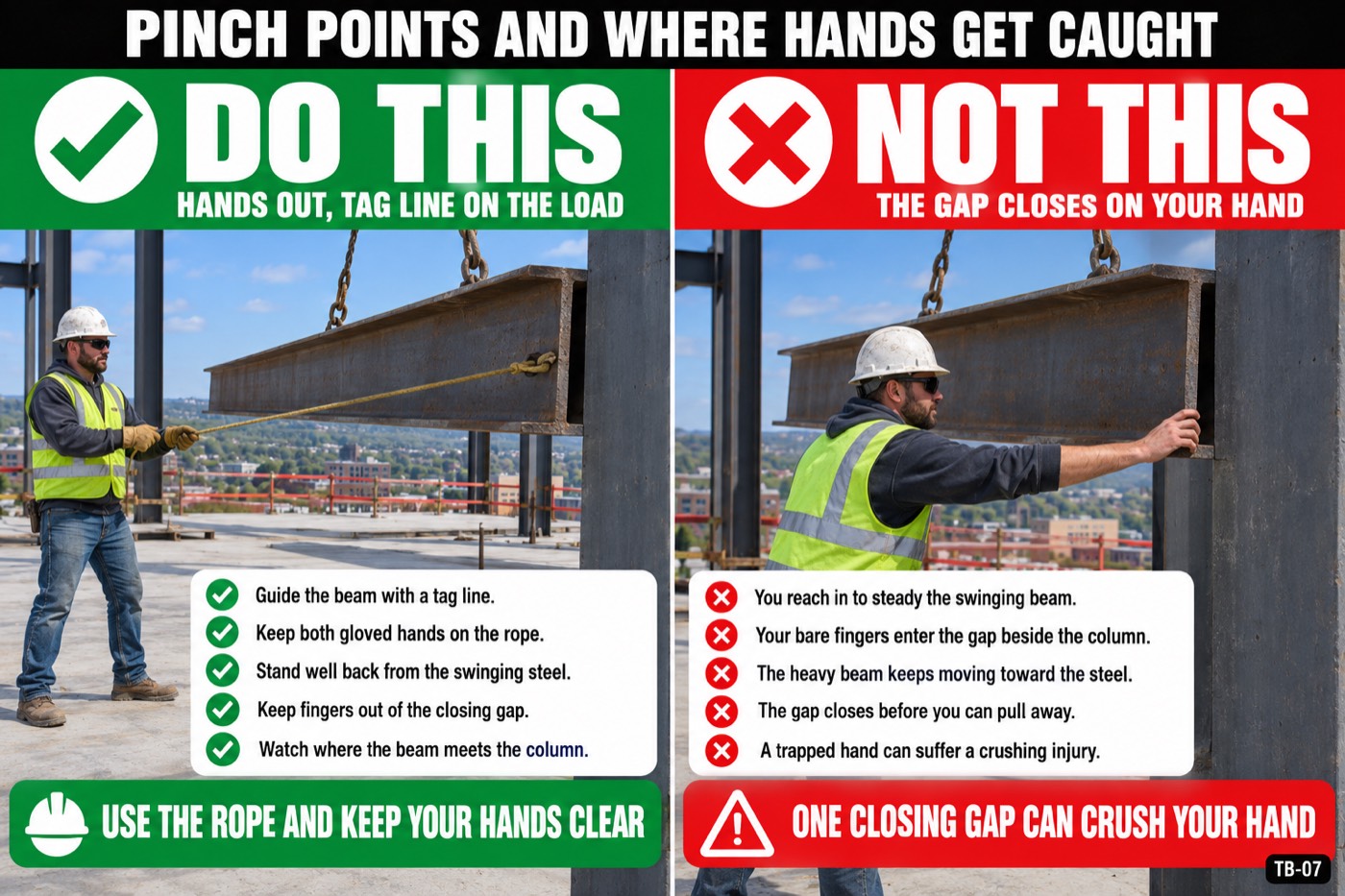
Put your hands up. Those are the ones you get. There is no second set in the truck.
The points
- A pinch point is anywhere two things come together. Once your hand is in one, the machine wins.
- Never put a hand where you wouldn't put your face.
- Use a bar, a hook, or a tag line to guide loads. Not your fingers.
- Guards stay on. If a guard is missing, the tool is out of service.
- Rings, loose sleeves, and gloves near rotating parts pull you in. Take them off around spinning equipment.
Why it goes wrong
Hand injuries are among the most common injuries in construction, and degloving or amputation from a pinch point is life-changing in a way a cut isn't. The hand is in the wrong place for a fraction of a second and that's enough.
Many pinch-point injuries happen during setup, adjustment, and cleanup, not during production work. That's when guards are off and people are reaching in.
The reason a pinch point wins every time is that there is nothing to react to. Human reaction time is a couple of tenths of a second at best, and a load swinging into place, a hydraulic closing, or a chain taking up slack covers that distance in less. By the time you feel it, the decision was made when you put the hand there.
Gloves near rotating parts make it worse rather than better. A glove catches on a drill bit, a shaft or a chuck and pulls the whole hand in, where a bare hand might have slipped clear. Same for rings, watches and loose sleeves - anything the machine can grab is a handle it uses to pull you in.
A guard that is missing is not a machine to be careful around, it is a machine out of service. Guards get removed for a reason, usually a legitimate one, and the failure is that they do not go back on before the tool gets used again.
Questions for the crew
- Where are the pinch points on the equipment we're running today?
- Has anyone here had a close call with their hands? What happened?
- Is there a tool we could use instead of reaching in?
To close
If you catch yourself reaching into something today, stop and find a bar or a hook instead.
To hold this talk with your crew
1
Read it aloud. Five minutes, before the work starts.
2
Ask the questions. A crew that talks is a crew that remembers.
3
Have them sign on their own phones, and the record is sealed.