Power trowels indoors: the exhaust is what kills
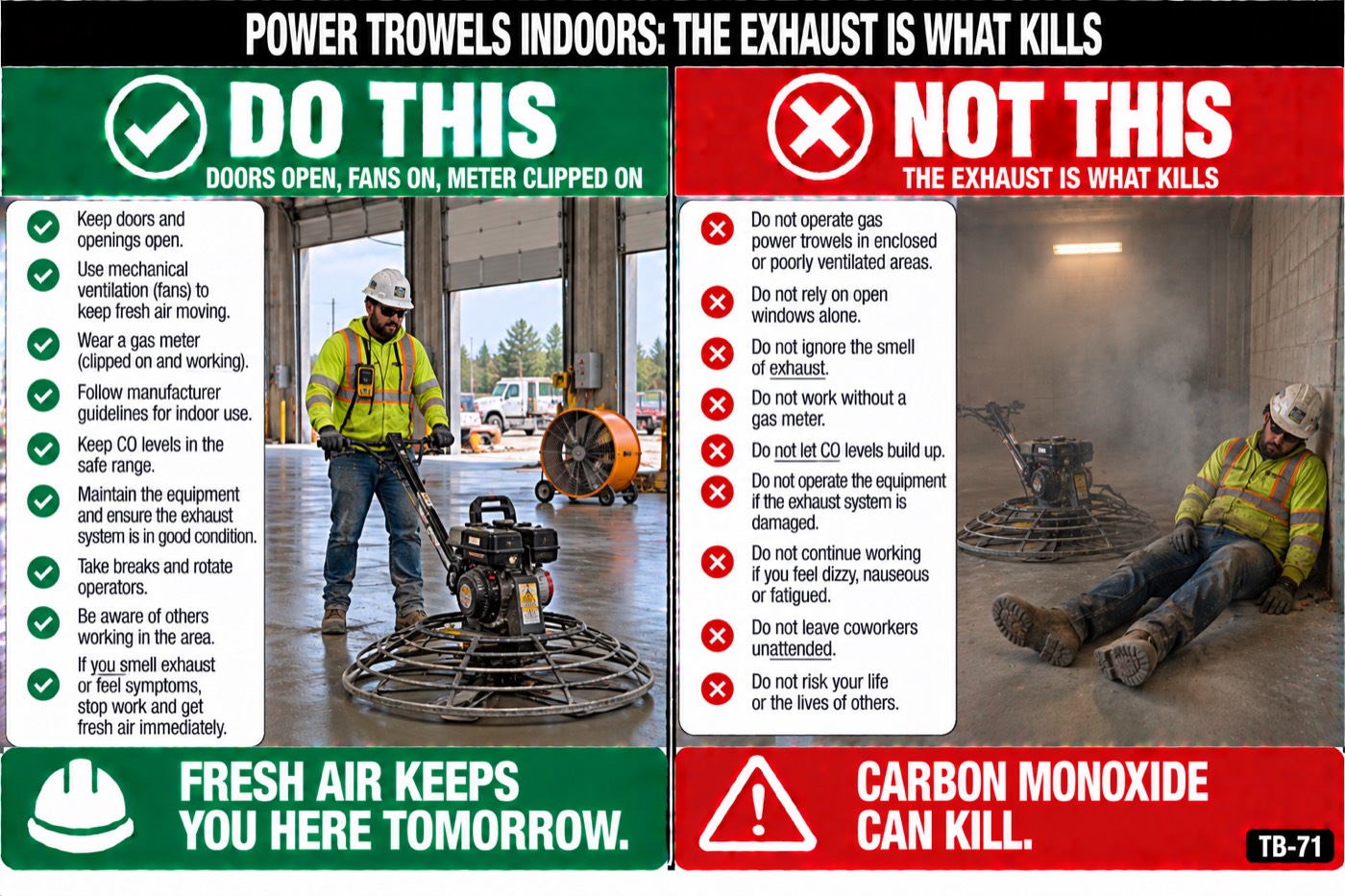
A gas power trowel running in a closed basement can put out enough carbon monoxide in half an hour to put a finisher on the slab. You cannot smell it, and the first symptom is a headache the crew blames on the long day.
The points
- Finishers have died running gas trowels in enclosed pours: a basement, a building with the walls up and the doors shut against the weather, a heated tent in winter. Carbon monoxide has no smell, and by the time someone feels sick they are already in trouble.
- The limit is 50 parts per million averaged over a shift. A small gas engine indoors passes that in minutes. An enclosed pour means electric or propane machines with a CO meter running, or gas engines only with the exhaust piped outside and the meter still running.
- A walk-behind trowel has to shut off when your hands leave the handles. If the deadman is tied down, wired open or broken, the machine is out of service until it is fixed.
- When a trowel blade catches a chair or a hard spot, the machine spins around the blade and the handle comes around at hip height. Feet stay clear of the blade ring, and nobody reaches under a running machine.
- Slab saws and cut-off saws on a wet slab: guard on, a blade rated for the saw's RPM, the cord on a GFCI, and both hands on the handles with the cut line clear of your leg.
Why it goes wrong
Carbon monoxide binds to your blood about 200 times more tightly than oxygen does, so it takes the oxygen's place and your body starves with every breath. At 200 parts per million you get a headache in 2 to 3 hours. At 400 it is life threatening after 3 hours. At 1,200 it is immediately dangerous. A 5-horsepower gas engine in a closed room gets there faster than you would guess.
An open door is not ventilation. Ventilation is fans moving air through the space and a CO meter that alarms, usually set around 35 parts per million. Anyone with a headache, dizziness or nausea comes out to fresh air and stays out. The person who runs back in without air to drag out a downed worker goes down next to them.
29 CFR 1926.55 sets the limit at 50 parts per million as an 8-hour average. 29 CFR 1926.702 says a manually guided power trowel has a control switch that shuts the power off when the operator's hands leave the handles. Both rules exist because of bodies.
A walk-behind trowel spins a 36 to 48 inch blade ring at 100 to 200 RPM. When a blade edge catches a rebar chair, a lump or a hard edge, the torque goes to the handle instead of the blades, and the machine tries to swing around the operator. The deadman is what stops it when the operator lets go. A tied-down deadman means a running machine going across the slab on its own.
Slab saws and cut-off saws kick back when the top of the blade binds in the cut, and a 14-inch blade comes up at the operator's face and chest. Keep the water running, do not twist the saw in the cut, and never cut with the top quarter of the blade. Water plus an electric saw means the GFCI is not optional.
Propane engines burn cleaner than gas but still make carbon monoxide, especially when the engine is running rich. Generators and gas-powered saws inside a building count the same as a trowel. If there is a gas engine of any kind indoors, there is a meter running next to the crew.
Questions for the crew
- Is any part of today's pour enclosed enough that an engine's exhaust stays in with us, and what machines are going in there?
- Who has the CO meter today, and what number does it alarm at?
- Has anyone tied down or bypassed a deadman on our trowels, and does anybody know why?
To close
No gas engine runs inside an enclosed pour today without a meter running, and a headache in there stops the machine and brings the crew out to air.
To hold this talk with your crew
1
Read it aloud. Five minutes, before the work starts.
2
Ask the questions. A crew that talks is a crew that remembers.
3
Have them sign on their own phones, and the record is sealed.