Demolition survey: what has to be found first
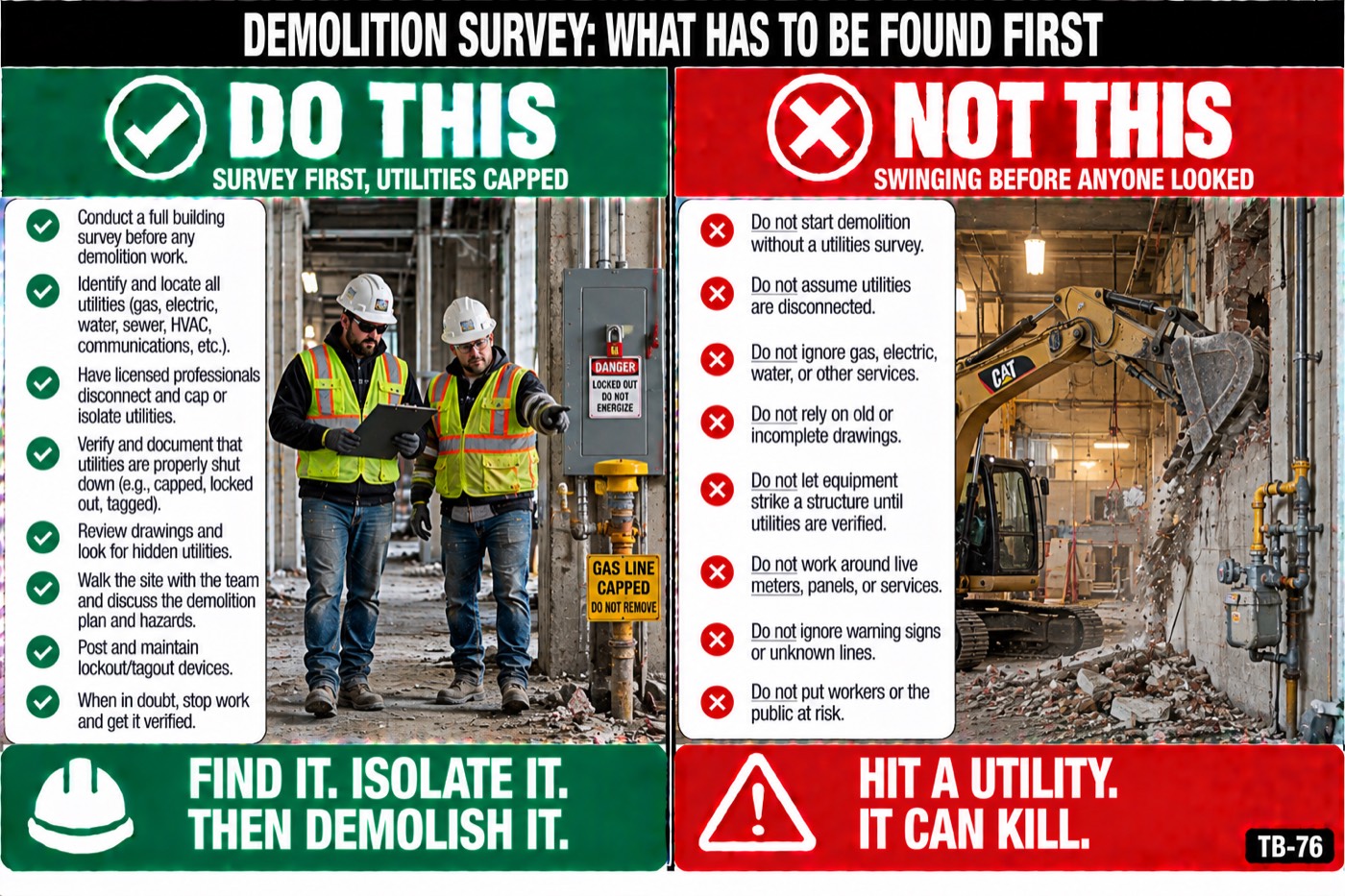
Before the first wall comes down, somebody has to have looked at the whole building and written down what is holding it up and what is still inside it. If that paper does not exist, the crew is guessing with a building.
The points
- Buildings come down on demolition crews in the wrong order because nobody found out that a partition was carrying the floor above, or that the fire three years ago had already cooked the steel.
- A competent person does an engineering survey before demolition starts: the condition of the framing, floors and walls, the chance of an unplanned collapse of any part, and the same for the buildings next door. It is written down and it is on the job.
- Every electric, gas, water, steam and sewer line into the building is shut off, capped or controlled outside the building before work starts, and the utility company is told ahead of time.
- Any pipe, tank or piece of equipment that might have held chemicals, gas, explosives or flammable material gets tested and purged before anyone cuts into it.
- A building damaged by fire, flood or explosion gets shored or braced before anyone goes in to work. The survey says where.
Why it goes wrong
The survey answers the questions the crew cannot see from the ground. Which walls are bearing and which are partitions. Where the load path runs from the roof to the footings. Whether there are cantilevers, post-tensioned slabs or precast pieces that behave differently when cut. What the floors can carry now, not when they were built. What the concrete and steel look like after 60 years of water, and after any fire.
29 CFR 1926.850 lists it: a competent person's engineering survey of the structure and any adjacent structure, in writing, before work starts. Damaged buildings shored or braced before entry. All service lines shut off, capped or controlled outside the building line, with the utility notified. Any pipe, tank or equipment that could hold chemicals, gas, explosives or flammable material tested and purged. And demolition proceeds from the top down, story by story.
Utilities are where the survey most often gets taken on faith. A breaker flipped in the panel is not a line shut off outside the building. Gas gets capped at the meter or the main, not at an appliance. A neighbor's feed or a second service can be in the same wall. Every line the crew works near gets tested dead with a meter or a gas detector on the morning of the work, by someone who knows how to read it.
Tanks and equipment hold what they held. An underground fuel tank, a boiler, a transformer with PCB oil, a compressor with a receiver, a refrigeration system with charge in it, a process line with a residue. The survey names them, and each one is tested and purged before a torch or a saw goes near it. An empty tank with vapor in it is the one that explodes.
The survey is not a document for the office. The foreman walks the crew through what it says before the first day: which walls carry load, the order the building comes down in, where the safe zones are, where debris goes. If the building does not match the survey, the wall that should be a partition is solid block or the beam that should be steel is timber, the work stops and the person who wrote the survey comes back.
Adjacent structures are part of the survey because they share things: a party wall, a foundation, a sidewalk vault, a sewer lateral. Pulling a wall that the neighbor's floor joists bear on brings the neighbor's floor down. The survey says what is shared and what has to be supported before it is cut loose.
Questions for the crew
- Who did the survey for this building, and has everyone here seen what it says about the bearing walls and the order?
- Which utilities are confirmed dead, and who confirmed them with a meter, not with a phone call?
- What is in this building that could still be holding gas, fuel or chemicals?
To close
Nobody cuts, pulls or drops anything today that the survey did not cover, and if the building does not match the survey we stop and get the person who wrote it.
To hold this talk with your crew
1
Read it aloud. Five minutes, before the work starts.
2
Ask the questions. A crew that talks is a crew that remembers.
3
Have them sign on their own phones, and the record is sealed.