Behind the wall: asbestos, lead and live lines
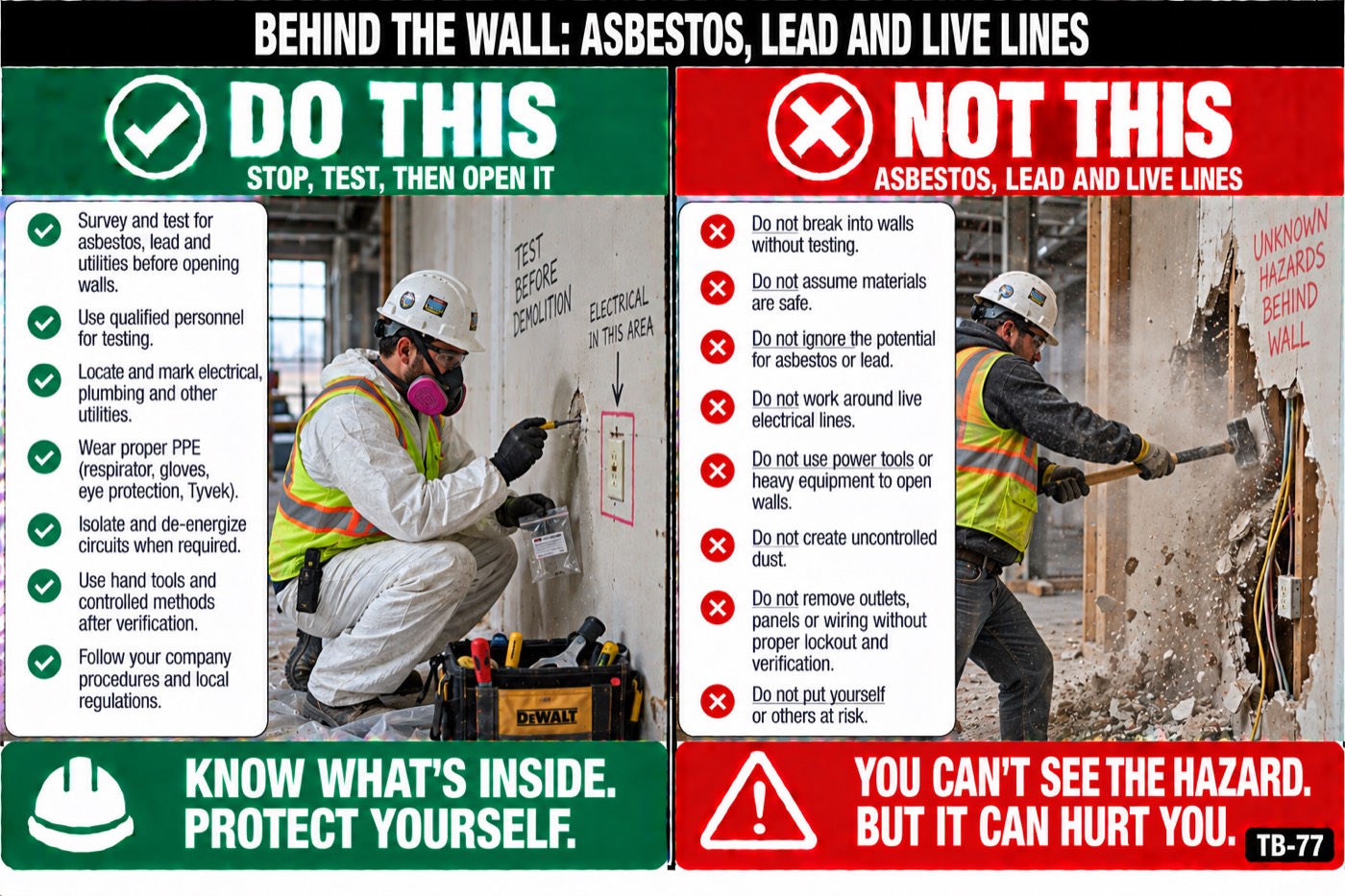
In any building put up before 1981, the pipe insulation and the sprayed or troweled ceilings are asbestos until a lab says otherwise. The rule says presume, and the fibers you breathe cutting into it stay in your lungs for life.
The points
- Demolition crews breathe asbestos and lead dust and cut into lines nobody found. Asbestos disease shows up 20 to 40 years later as mesothelioma or lung cancer, and there is no fixing it then.
- In buildings built before 1981, thermal system insulation and surfacing material are presumed asbestos until tested. The owner and the employer have to identify it before work starts, and removing it is a trained, licensed job done under a containment, not something this crew does with a pry bar.
- Paint in anything built before 1978 is presumed lead until tested. Torching, grinding or dry scraping lead paint puts lead in the air, and it goes home on your clothes to your kids.
- Lines that were shut off get proven dead with a meter and a gas detector, not by cutting into them. Every wall, ceiling and floor cavity can hold a line nobody mapped.
- Tanks, drums and pipes get tested and purged before anyone cuts them. A torch into a fuel tank that was empty for years is a bomb, because the vapor is what explodes, not the liquid.
Why it goes wrong
29 CFR 1926.1101 sets the limit at 0.1 fiber per cubic centimeter averaged over 8 hours, with a 30-minute excursion limit of 1 fiber. Those are fibers you cannot see. A paper dust mask does nothing. Removing pipe insulation and surfacing material is Class I work, with trained workers, wet methods, respirators, and a negative pressure enclosure. The demolition crew's job is to know what it looks like and not touch it.
What asbestos looks like on a demo job: white or gray wrap on pipes and boilers, 9-inch floor tile and the black mastic under it, popcorn and troweled ceilings, transite panels and siding, roofing felt and mastic, fireproofing on steel, gaskets and joint compound. The rule says thermal system insulation and sprayed or troweled surfacing in a building built by 1980 is presumed asbestos until an accredited inspector tests it. Find it in the survey before you find it with a hammer.
Lead paint is covered by 29 CFR 1926.62. The action level is 30 micrograms per cubic meter of air and the limit is 50. Cutting a painted steel beam with a torch puts lead fumes in the air at many times that. Lead builds up in blood and bone and takes months to leave. Wash before you eat, change before you drive home, and do not shake the dust off your clothes in the truck.
A line that was shut off is a story until it is tested. The meter reads zero on the panel, the gas detector reads zero at the cut, the water is drained, not just valved. Demolition crews find live 480-volt feeds in walls, gas lines that were abandoned but never capped, and pressurized lines from a system in the next building. If a line shows up that is not on the drawings, it is live until proven otherwise.
Tanks explode from vapor. A tank that held gasoline, solvent or fuel oil years ago still has vapor in it, and a torch or a grinder spark is the ignition. Each tank, drum and process pipe is tested with a meter for flammable vapor, purged and tested again before it is cut. The same for anything with a pressure gauge on it, and for refrigeration lines that still have charge.
Other things behind the wall: mold, bird and bat droppings in attics and ductwork, needles and drug residue in vacant buildings, PCBs in light ballasts, mercury in old thermostats and switches. The rule for all of it is the same: if you open something and find what you did not expect, stop, back off, and get it identified before anyone breaks it.
Questions for the crew
- When was this building built, and what did the asbestos and lead survey find, and where is that report right now?
- What are we going to do today if we open a wall and find pipe wrap, tile, or a line that is not on the drawings?
- Who has the meter and the gas detector, and has every line we are working near been tested dead this morning?
To close
Nobody cuts, breaks or torches into anything today that has not been tested or identified, and finding something unexpected stops the work until we know what it is.
To hold this talk with your crew
1
Read it aloud. Five minutes, before the work starts.
2
Ask the questions. A crew that talks is a crew that remembers.
3
Have them sign on their own phones, and the record is sealed.