Solvent cement: the fumes in a closed bathroom
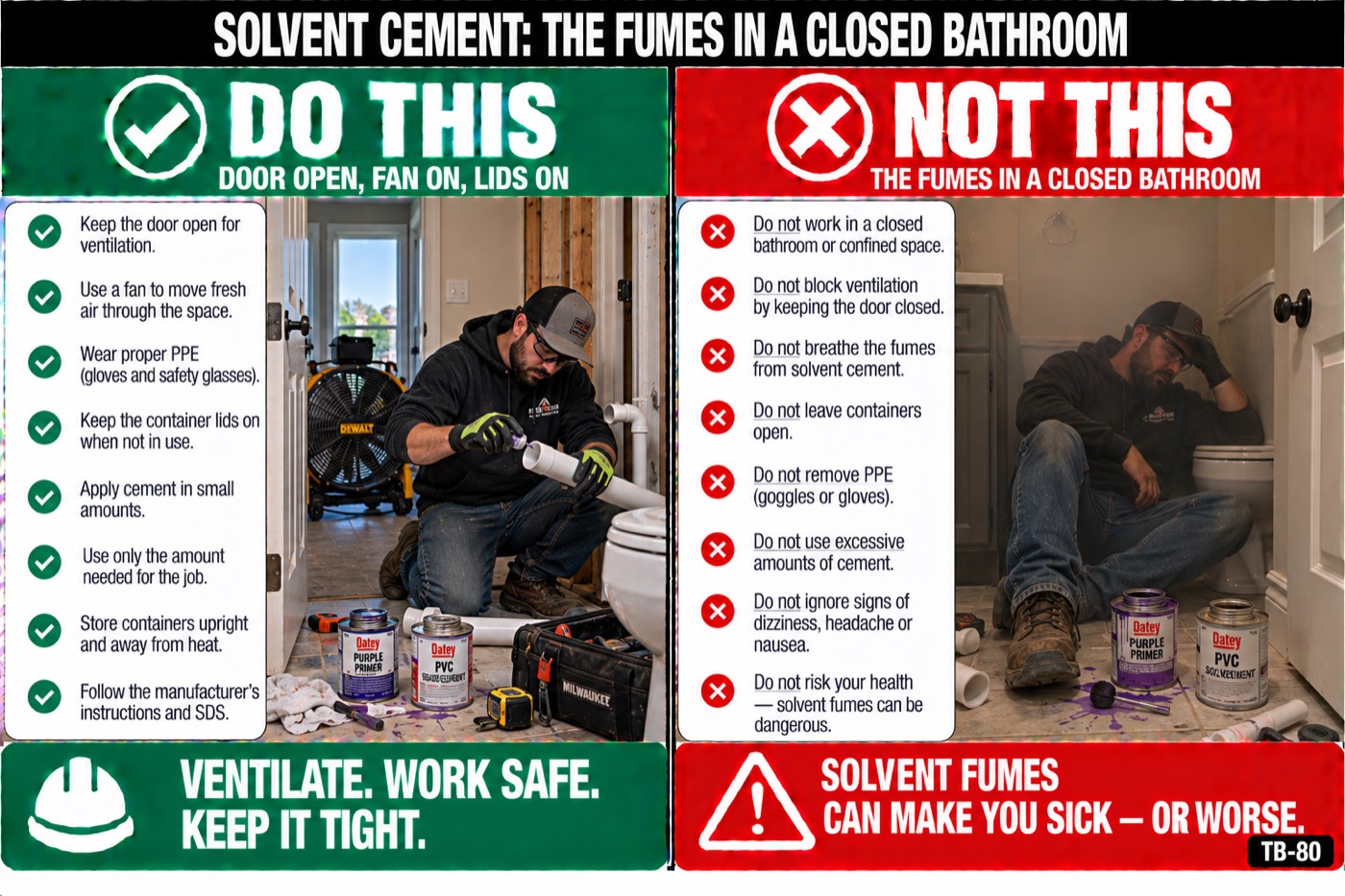
The solvent in PVC cement and purple primer has a flash point around 6 degrees. On the coldest morning you will ever work, that can of glue is still ready to burn.
The points
- A 5-by-8 bathroom with the door shut holds about 320 cubic feet of air. A few joints of primer and cement in there gets you a headache first, then dizziness, and a vapor cloud that a pilot light or a heat gun can light.
- The rule says vapor in the air you breathe stays under the limit in 1926.55, and if you are using ventilation to get there, the ventilation has to actually work. A window that is open a crack is not ventilation.
- Door open, window open, and a fan blowing the air out of the room, not around it. If you can smell it strong after the second joint, the air is not moving enough.
- No flame or spark within reach of the vapor: no water heater pilot, no torch, no heat gun, no smoking. The vapor is heavier than air and pools on the floor near the drain you are working on.
- Lid on the can between joints, dauber in the can, and the can stays off the floor of the room where the vapor pools. Gloves from the SDS, not the nitrile pair in the truck, because these solvents soften nitrile in minutes.
Why it goes wrong
PVC and ABS cements are mostly tetrahydrofuran, methyl ethyl ketone, cyclohexanone and acetone. THF flashes at about 6 degrees F and MEK at about 16 degrees F, which means both are giving off a flammable vapor at any temperature you will ever work in. The OSHA limit for both is 200 parts per million over a shift, and a small closed room gets there on a couple of joints.
The first symptom is the headache. Then comes light-headedness, nausea and the feeling that you are working slower than you are. That is the solvent acting on your nervous system, and the crew member who says he is used to the smell is the one who has stopped noticing it, not the one who is safe from it.
The vapors are heavier than air. They sink to the floor and into the tub or the shower pan you are working over, and they run along the floor to the water heater closet or the furnace. That is how a bathroom that smelled fine at head height lights off at the pilot.
Ventilation means moving the vapor out of the building. A box fan in the doorway pointed out of the room, with a window open on the other side for makeup air, changes the air in a bathroom every couple of minutes. A fan pointed at your face just moves the vapor past your nose faster.
Skin counts too. Primer and cement on your hands goes through the skin, and the solvents eat ordinary nitrile gloves in a few minutes. The SDS for the cement lists a glove that holds up, and a dauber with a handle keeps your fingers out of the can.
The common mistake is the one-joint job. You shut the door for the noise or the cold, prime and glue three fittings, and stay in there to hold the joint. Thirty seconds of holding a joint in a closed room is the exposure the rule is talking about.
Questions for the crew
- Which room today is the one with the door that has to be shut, and how does the air get out of it?
- Where is the nearest pilot light, heater or torch to where the cement is being used?
- What gloves are in the truck for this cement, and has anyone looked at the SDS for it?
To close
Any room where cement or primer is used today has the door open and a fan moving air out before the first joint is glued.
To hold this talk with your crew
1
Read it aloud. Five minutes, before the work starts.
2
Ask the questions. A crew that talks is a crew that remembers.
3
Have them sign on their own phones, and the record is sealed.