Soldering in a wall: the fire that starts later
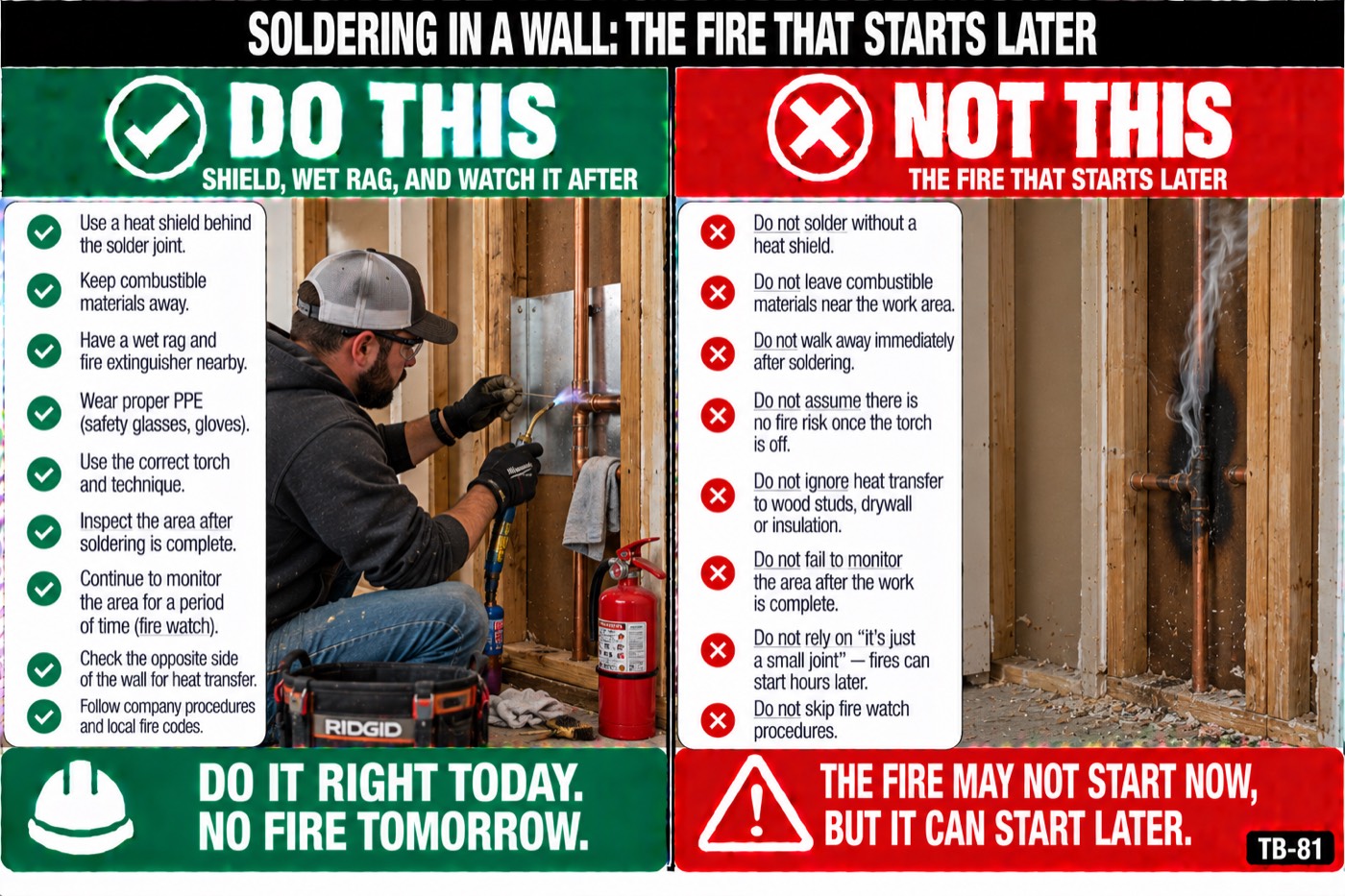
A propane torch flame runs about 3,600 degrees. The stud four inches behind that copper stub starts to char at 500, and it does not need to flame to be on fire.
The points
- The fire that a plumber starts is usually found two or three hours after the truck leaves. Heat soaks into the wood behind the fitting, it smolders inside the wall, and it breaks out when nobody is there to stop it.
- The rule is fire prevention for any heating work: move what can burn or shield it, have an extinguisher in the work area ready to use, and when the ordinary precautions are not enough, post a fire watch during and after the work.
- Before the torch lights: a heat shield or wet rag behind the joint, the insulation and paper pulled back, sawdust and shavings swept out of the bay, and a water spray bottle and an extinguisher within reach, not in the truck.
- After the last joint: put your hand near the wood, look at the back side of the wall or floor, and stay 30 minutes. A joint in a crawl space or an attic gets checked from both sides before you climb out.
- Burns come from the pipe, not the flame. A soldered joint is over 400 degrees and looks exactly like a cold one, so nobody grabs the pipe until it has been wiped and cooled, and molten solder drips get a sleeve and safety glasses, not a bare forearm and squinting.
Why it goes wrong
Solder melts between about 415 and 460 degrees F, so the copper at the joint is at least that hot and the flame that got it there is ten times hotter. Wood begins to break down and char at about 500 degrees, and wood that has been heated and cooled several times chars at lower temperatures each time. The joist behind a fitting that has been re-sweated three times over the years is the one that goes.
Smoldering is the mechanism. The flame touches the paper on the insulation or the dry edge of a stud, it glows without a visible flame, and it works its way into the wall cavity where there is air and nothing to stop it. That is why 1926.352(e) says the fire watch continues for a sufficient period after the work, and why the general-industry number for that period is at least 30 minutes.
1926.352(f) says heating on a wall, floor or ceiling needs the same precautions on the other side, because heat and sparks go through. The floor above a crawl space joint, the back side of the wall you opened, and the ceiling under the attic all count as the other side.
MAPP and propane cylinders leak at the valve and at the torch connection. In a crawl space or a closet, that gas pools, and 1926.352(g) says the supply gets shut off outside the enclosed space when the torch is not in use and the torch and hose come out overnight. A torch left running on the floor while you reach for a fitting is a torch pointed at something.
Flux is acid. Splashed in the eye it burns, and boiled off the joint it makes fumes that sting. Safety glasses stay on, the flux brush stays out of the pocket, and hands get washed before food. Lead-free solder still has other metals in it, and the fumes from overheating a joint are not something to breathe in a closed space.
The common mistake is the heat shield that is not there. A fitting 2 inches off a stud, a quick joint, and the thought that the flame is pointed at the copper and not the wood. The flame wraps the pipe and comes out the other side, and that is where the wood is.
Questions for the crew
- Which joints today are inside a wall, a floor bay or a ceiling, and what is on the other side of each?
- Who is the fire watch after the last joint, and where is the extinguisher going to sit while the torch is lit?
- Where does the cylinder get shut off when you set the torch down in that crawl space?
To close
Nobody lights a torch in a wall or a bay today without a heat shield behind the joint, an extinguisher within reach and someone checking the wood 30 minutes after the last joint.
To hold this talk with your crew
1
Read it aloud. Five minutes, before the work starts.
2
Ask the questions. A crew that talks is a crew that remembers.
3
Have them sign on their own phones, and the record is sealed.