Crawl spaces and attics: the joist you step between
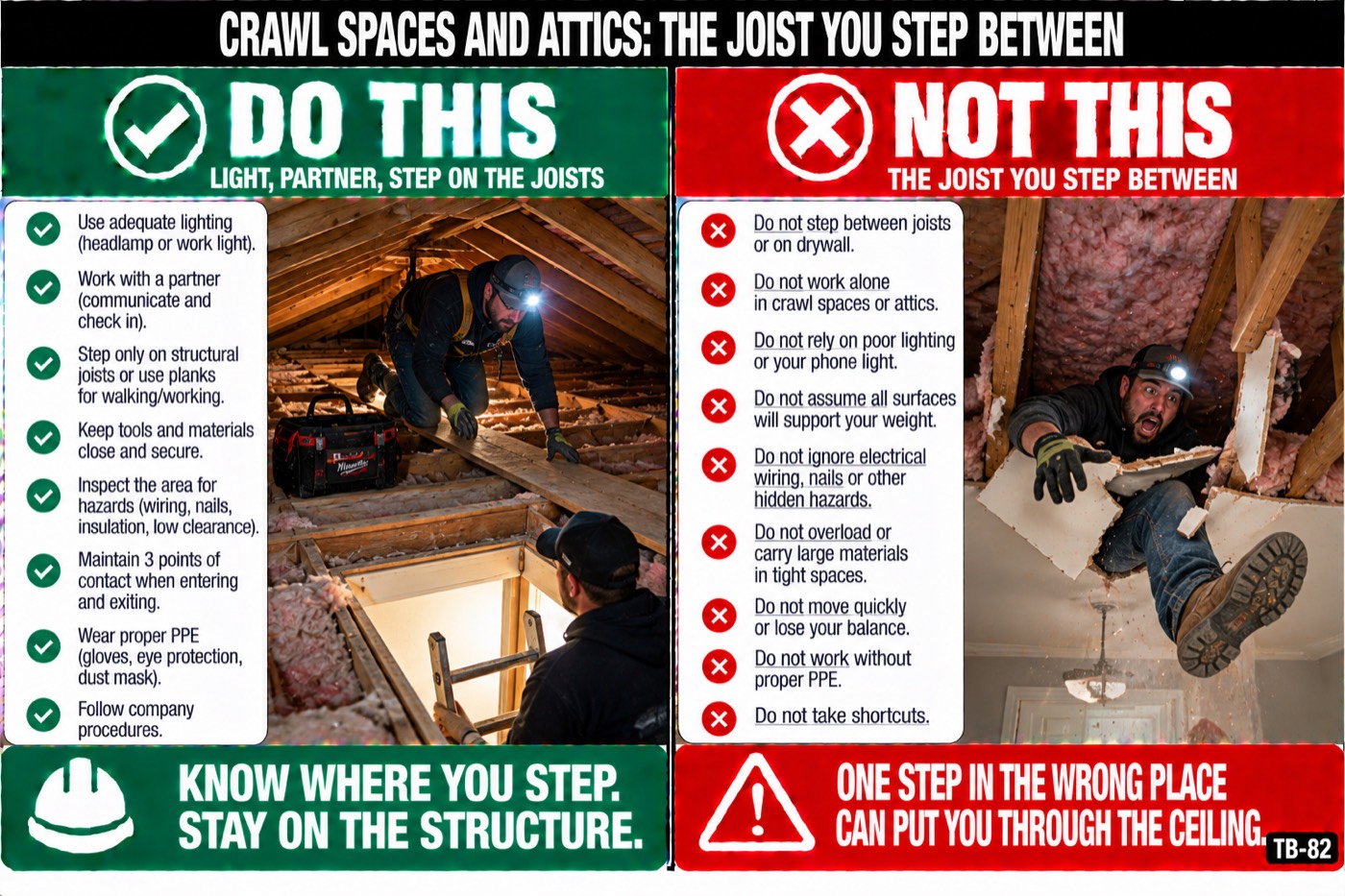
An attic in August runs 130 to 150 degrees at the ridge. The drywall between the joists holds a light fixture, and it does not hold you.
The points
- Two ways people get hurt up there: they step between the joists and go through the ceiling 8 feet onto whatever is below, or they overheat alone in a space nobody checks. Both are quiet and both happen to people who have done it a hundred times.
- The employer's duty under 1926.20(b) is to inspect the work and the place before the crew goes in, and that is the foreman standing at the hatch asking what is in there. Nothing specific tells you how to walk an attic; the joists and the heat do.
- Attics: walk the joists or lay a plank across three of them, headlamp plus a second light, and stay below the roofing nails coming through the deck at head height. Crawl spaces: know the way out before you go in, and never wedge yourself into a spot you cannot back out of.
- Heat: attic work happens early in the day, 15 minutes in and 15 minutes out in the heat, water at the hatch, and the moment you stop sweating or feel confused, you come down. A crawl space in summer is cooler but has its own air, and a gas smell or a sewer smell means out, not through.
- Nobody works one of these alone without a check-in. Somebody knows where you are, calls or yells to you every 20 to 30 minutes, and comes looking if there is no answer. There is no phone signal under most slabs.
Why it goes wrong
The ceiling is 1/2-inch drywall screwed to the bottom of the joists. It carries its own weight and a light. A foot that comes down between joists onto that drywall goes through it, and the fall is the full height of the room below, onto a counter, a toilet or a tile floor. Kneeling on a 2-foot-wide piece of plywood spread across three joists is how you get to the fitting without the drywall carrying you.
Attic heat is not the outdoor temperature. A dark roof on a 95-degree day puts the air under the deck at 130 to 150 degrees, and the body cannot shed heat in that. Heat exhaustion looks like heavy sweating, cramps, headache and nausea. Heat stroke is when the sweating stops, the person gets confused or clumsy, and that is an emergency measured in minutes, not a break.
Crawl spaces have animals and what they leave. Rat and mouse droppings can carry hantavirus, which you get by breathing the dust when you disturb them; bat and bird droppings can carry histoplasmosis. Do not sweep dry droppings. Wet them down, wear a P100 or an N95 and gloves, and treat a raccoon or a snake as something that goes first, not something you share the space with.
Insulation is fiberglass or blown cellulose. Fiberglass in the eyes and on wet skin is a bad day; in the lungs it is a cough for a week. Long sleeves, gloves, glasses and a dust mask. Old vermiculite insulation, the gray-brown pebbly kind, may contain asbestos, and that is a stop, not a shovel.
Old houses have knob-and-tube wiring and splices lying open in the insulation. An attic floor covered in insulation is an attic where you cannot see the wire you are about to lean on. Light it, look before you put a hand down, and kill the attic circuits if you are going to be in the insulation.
The way out is the way in, usually a 22-by-30-inch hatch or an 18-inch crawl space opening. A person who is hurt, overheated or unconscious cannot come out that way on their own. That is why someone on the outside, a way to reach them, and a plan for how you would pull someone to the opening are part of the job before the job starts.
Questions for the crew
- Who is going into the attic or crawl space today, who is checking on them, and how often?
- What is the temperature going to be up there by the time the work starts, and when does that mean the work happens?
- What is between you and the hatch, and could you drag someone to it?
To close
Nobody goes into an attic or crawl space today without a light, a plank, water, and someone who is checking on them every 30 minutes.
To hold this talk with your crew
1
Read it aloud. Five minutes, before the work starts.
2
Ask the questions. A crew that talks is a crew that remembers.
3
Have them sign on their own phones, and the record is sealed.