Drywall dust: the sanding that fills the room
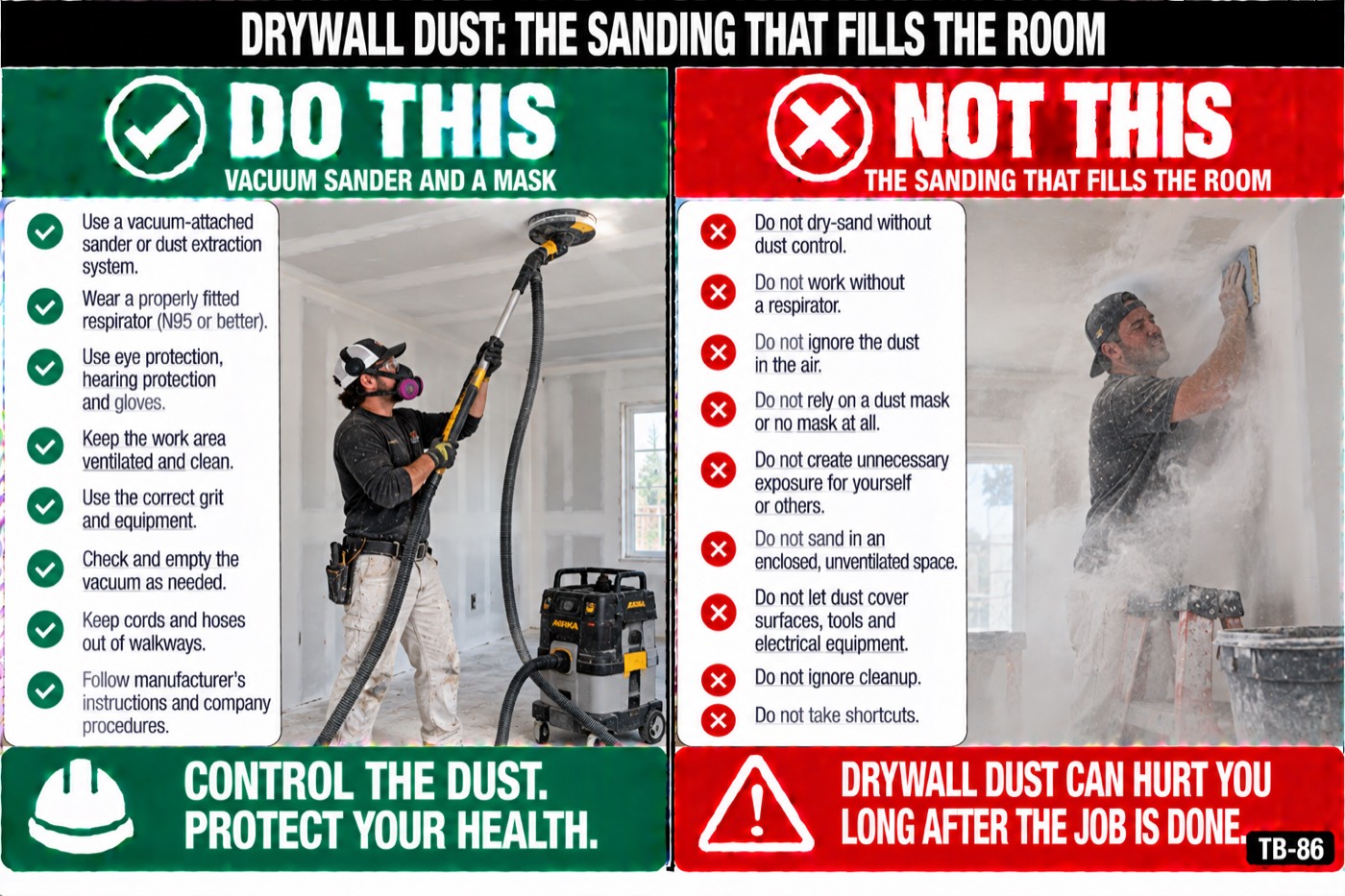
The OSHA limit for the fine gypsum dust you cannot see is 5 milligrams in a cubic meter of air. Dry-sanding one closet with a pole sander puts you past that in the first few minutes, and the cloud stays until somebody moves it.
The points
- Joint compound dust is not silica, and it still coats the lung. Years of dry sanding without a respirator means a chronic cough, bronchitis and lungs that do not clear, and the finisher who says it is just gypsum is the one coughing in the truck at 50.
- The rule is the air contaminant limit in 1926.55. For calcium sulfate, which is gypsum, that is 15 milligrams per cubic meter total dust and 5 respirable over a shift, with engineering controls first and a respirator when the controls cannot get you there.
- Sanding: a vacuum pole sander or a hand sander hooked to a HEPA vac, wet sponge sanding on the small stuff, and an N95 at minimum when the dust is in the air anyway. Doors to finished rooms closed and the return air grille covered so the furnace does not spread it through the house.
- Cutting cement board is a different job. Cement board is Portland cement and sand, and a saw through it makes silica dust, which is a separate rule and a separate lung disease. Score and snap, or shears, or a saw with a vacuum shroud, and a respirator that is fit-tested.
- Old walls: joint compound made before 1978 could contain asbestos. Sanding or demo on a wall from a house that old is a stop and a question, not a pole sander.
Why it goes wrong
Joint compound is gypsum, limestone, mica, talc and binders. The dust from sanding it is fine enough to go past the nose and throat and settle in the small airways, and a shift of dry sanding a room puts a finisher in the tens of milligrams per cubic meter. Some compounds also carry small amounts of crystalline silica in the fillers, and the SDS on the bucket tells you which.
For calcium sulfate, the 1926.55 limit is 5 milligrams per cubic meter of respirable dust as an 8-hour average, and 15 for total dust. For limestone filler dust the construction table sets only the 15 total limit. The room where you cannot see the far wall is far past both. An N95 stops the particles if it seals to the face, which means it goes on a shaved face and gets replaced when it clogs, not at the end of the week.
Vacuum sanding takes most of the dust out at the source. A pole sander with a HEPA vacuum on the hose, or a power sander with a vac, and you can see the difference in the room by the end of the first wall. Wet sponge sanding on the last coat makes almost no dust at all and is the right tool for a bathroom or a closet.
The dust travels. A furnace return in the room being sanded pulls the dust into the ducts and blows it into every finished room in the house, and it is still coming out of the registers a month after you are gone. Cover the returns, close the doors, put plastic over the doorway of the room being sanded, and sweep with a vacuum, not a broom.
Cement backer board is Portland cement and sand or fiberglass mesh. Cutting it with a circular saw or a grinder makes respirable crystalline silica, which is the dust that causes silicosis and is regulated under its own rule. Score-and-snap with a carbide scriber, shears for curves, and if it has to be sawn, a shrouded saw on a HEPA vac outdoors with a respirator.
The common mistake is the dust mask that is not a respirator. A paper mask with one strap, or an N95 with the bottom strap hanging, lets air in around the edges and gives you the feeling of protection with none of the filtering. Two straps, pinched nose, and a seal you can feel when you breathe in.
Questions for the crew
- What is getting sanded today, and is the vacuum sander on the job or on the truck?
- Is there cement board on this job, and how is it being cut?
- How old is this building, and has anyone asked what is in the walls we are sanding?
To close
Today every sander runs on a vacuum or wet, the returns are covered, and anyone in the dust cloud has an N95 sealed to the face.
To hold this talk with your crew
1
Read it aloud. Five minutes, before the work starts.
2
Ask the questions. A crew that talks is a crew that remembers.
3
Have them sign on their own phones, and the record is sealed.