Airless sprayers: the small hole that costs a finger
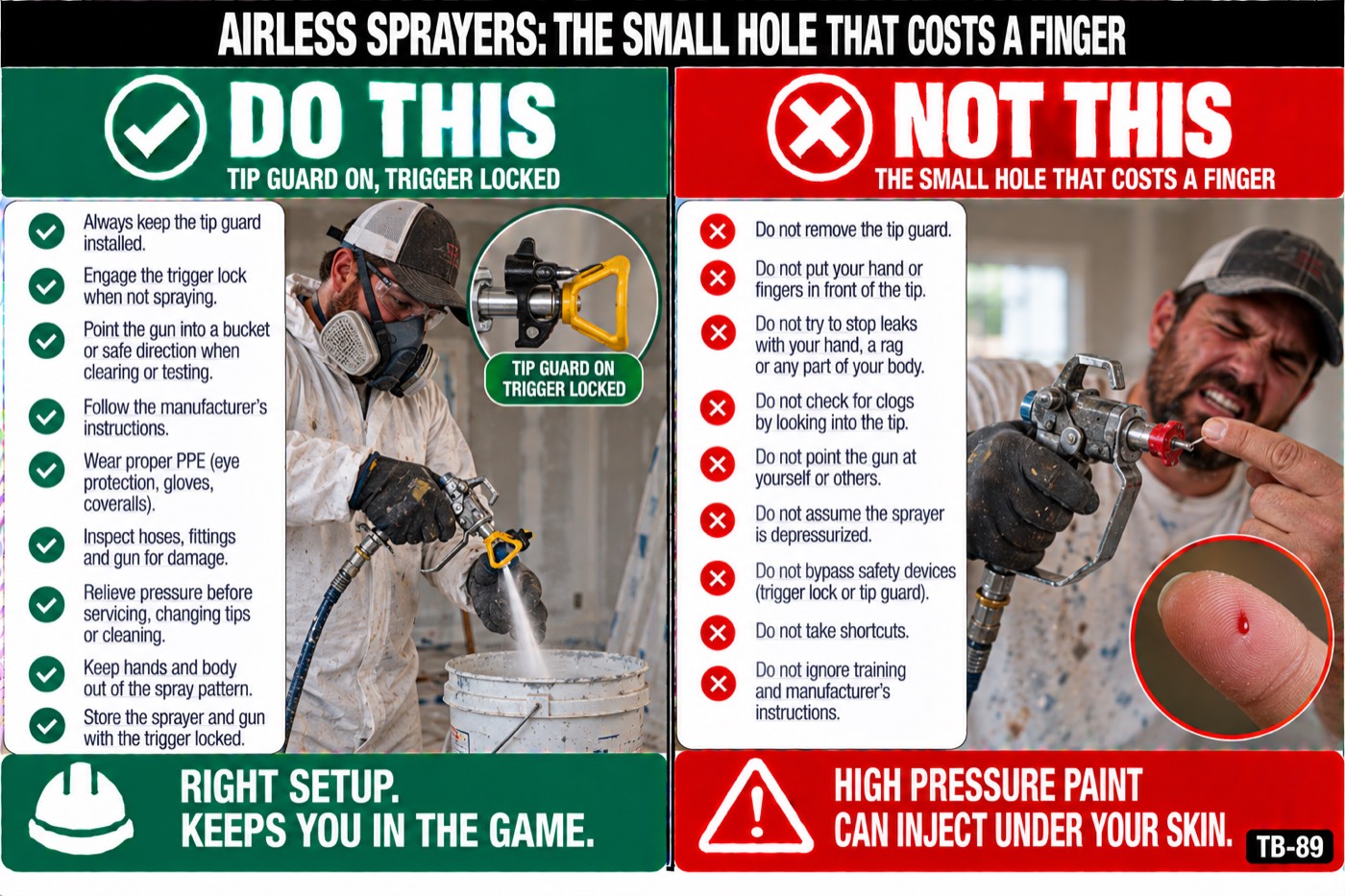
An airless sprayer pushes paint out of the tip at 3,000 PSI. Skin gives way at about 100. The mark it leaves looks like a splinter, and in six hours the hand can be past saving.
The points
- An injection injury does not look like anything. A pinhole, a little swelling, not much pain. Inside, the paint or solvent has spread along the tendons and the sheath of the finger, and it is killing tissue as it goes. Without surgery to open the hand and clean it out within hours, the finger comes off.
- The rule for airless guns at 1,000 PSI or more: a trigger safety that has to be released by hand before the gun will fire, or instead a diffuser nut that kills the high-pressure stream when the tip is off plus a tip guard that keeps the tip from touching the operator.
- Trigger lock on every time the gun leaves your hand, every time you clear a tip, every time you walk. Tip guard on the gun, always. Pressure relieved with the prime valve before any tip, hose or fitting comes off, and the hose checked for cuts and bulges at the start of the day.
- Never a hand in front of the tip. Not to feel for a clog, not to check the fan, not to wipe the tip. A clogged tip gets reversed and cleared with the gun pointed at the bucket, and never with a finger or a rag over it.
- If it happens: this is an emergency room visit right now, not tomorrow. Say the words high-pressure injection injury, say what the material was and the pressure, and take the SDS. Do not let anyone treat it as a cut. The pain comes later; the damage started at the tip.
Why it goes wrong
An airless pump runs 2,000 to 3,300 PSI to atomize paint without air. The stream at the tip is a fluid jet a few thousandths of an inch wide moving fast enough to cut skin at a touch, and the pressure behind it forces the material deep into the hand, up the finger and into the palm along the tendon sheaths. A hand held 6 inches from the tip is close enough.
The mechanism of losing the hand is the combination of pressure, chemistry and time. The paint or solvent is toxic to tissue, the pressure has spread it where the blood supply is thin, and the swelling closes off what supply there is. Amputation rates in the medical literature run from roughly a third to a half of injection injuries with paint and solvent, and the rate climbs with every hour before surgery.
1926.302(b)(8) requires an automatic or manual safety that prevents pulling the trigger until it is released by hand. 1926.302(b)(9) allows instead a diffuser nut that prevents high-pressure release with the tip removed, plus a tip guard that keeps the tip off the operator. Every airless gun sold has both the trigger lock and the guard; a guard that has been unscrewed to get into a corner is a gun that is out of compliance and waiting.
The hose is the part nobody thinks about. It carries 3,000 PSI, and a hose that is cut, kinked, driven over or connected with a fitting from a different rating fails at the weak spot and puts the same jet out sideways. Hoses get looked at at the start of the day, and pressure comes off with the prime valve and the trigger into the bucket before any connection is touched.
Solvent through an airless builds static, and static can ignite solvent. The machine is grounded, the gun is held against the metal rim of a grounded pail while flushing, and flushing with lacquer thinner happens outside or in a ventilated space with the same spark rules as spraying.
What to tell the ER matters because the injury is rare and it is misread as a minor puncture. High-pressure injection injury, the material, the pressure, the time it happened, and the SDS on the phone. The treating doctor needs a hand surgeon and an operating room, and the crew member who is told to go home with a bandage needs to say those words again.
Questions for the crew
- Whose gun is missing its tip guard, and where did it go?
- How does the pressure come off this rig before you change a tip, and who has done it that way today?
- Where is the nearest ER, and what are the words you say when you walk in?
To close
Every airless gun on this job runs with the tip guard on and the trigger locked whenever it is not spraying, and anyone with a mark from a tip goes to the ER before the truck moves.
To hold this talk with your crew
1
Read it aloud. Five minutes, before the work starts.
2
Ask the questions. A crew that talks is a crew that remembers.
3
Have them sign on their own phones, and the record is sealed.