Lead paint before 1978: the dust you take home
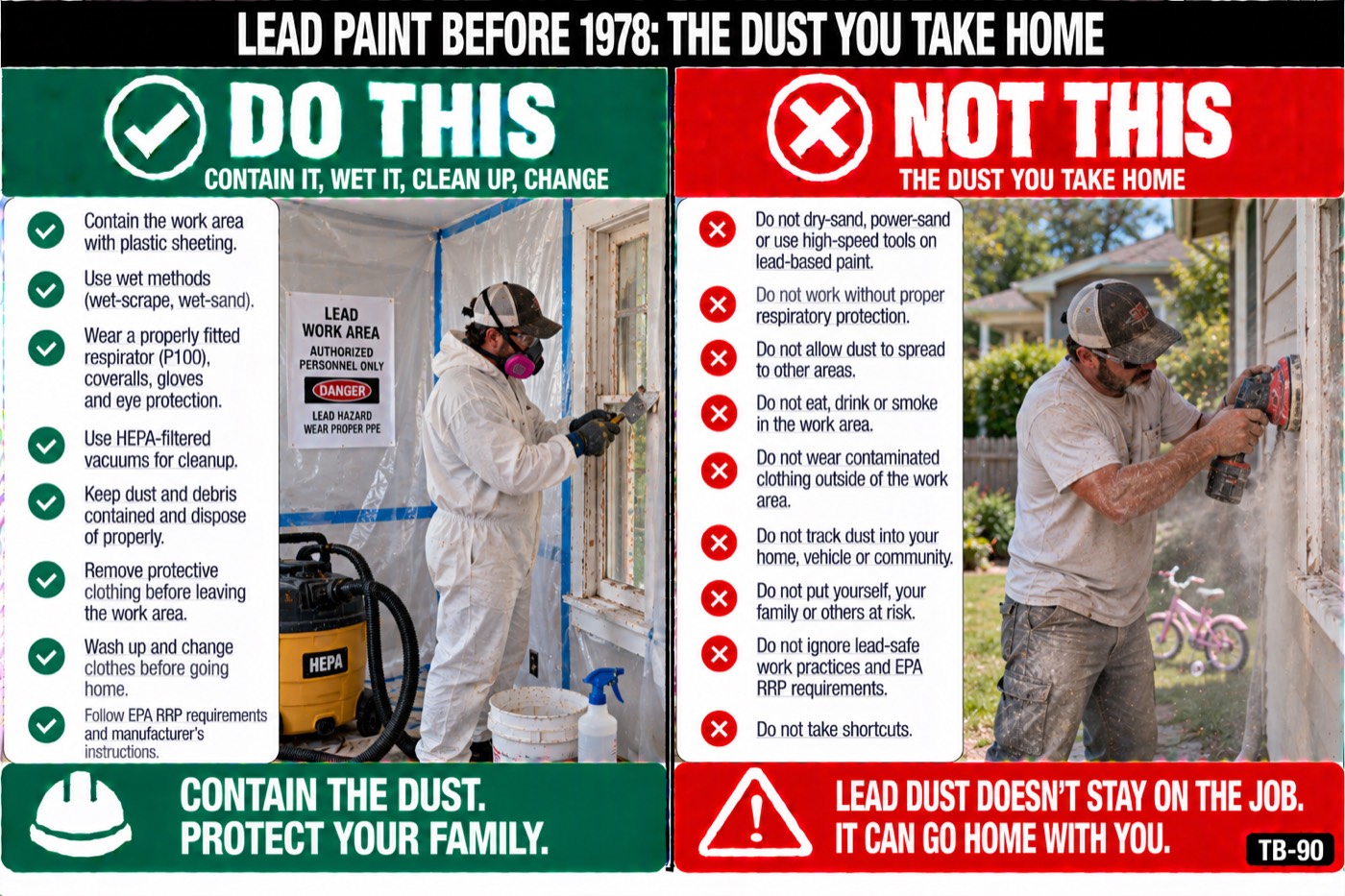
The house was built before 1978, so the paint under the paint has lead in it. Sanding a window sash for ten minutes puts more lead in the air than the rule allows for a whole shift, and the dust rides home on your shirt.
The points
- Lead does its damage quietly. Headache, stomach pain, tiredness, high blood pressure, and it does not leave; it settles in the bone and comes back out for years. Your kids get it from the dust on your clothes and your boots, and for a child there is no safe amount.
- The OSHA limit is 50 micrograms of lead per cubic meter of air over 8 hours, and the action level is 30. Manual sanding, scraping and heat-gun work on lead paint are assumed to be over the limit until air sampling proves otherwise, which means respirators, protective clothing, and a place to wash and change from the first day.
- EPA's RRP rule adds the work practices: signs, plastic on the floor 6 feet out from the work inside and 10 feet out outside, doors and ducts sealed, no open-flame burning, no heat gun above 1,100 degrees, and no power sanding or grinding without a shroud and a HEPA vacuum on it.
- Today: test kit or assume lead, containment up before the first scrape, half-mask with P100 filters, coveralls that stay on the job, HEPA vacuum and wet wiping for cleanup, and no food, drink or smoking in the work area.
- Going home: wash hands and face before you eat, coveralls off and bagged before you get in the truck, boots that do not walk into your kitchen. Blood lead testing is available to anyone on this work, and above 50 micrograms per deciliter the rule pulls you off lead work until it comes down.
Why it goes wrong
Lead paint was banned for residential use in 1978, so every house older than that is presumed to have it until a test says otherwise. It is in the layers under the top coat, on window sashes and sills, doors, trim, railings and exterior siding. Friction surfaces where windows and doors rub have been making lead dust for decades, and the sills and wells under them are where it collects.
1926.62(d)(2) lists tasks that are presumed over the limit when lead paint is present: manual demolition, manual scraping, manual sanding, heat gun work, and power tool cleaning with dust collection. Until the employer has air sampling showing otherwise, the crew doing those tasks gets respirators, protective clothing, change areas, hand washing facilities and blood lead testing. Abrasive blasting and power tool cleaning without dust collection are presumed higher still.
The number that matters at the doctor is blood lead, in micrograms per deciliter. Testing starts at the action level, and 1926.62(k) removes a worker from lead exposure when a periodic blood lead test and its follow-up test both come back at or above 50. There is no requirement to wait for symptoms, because the symptoms come late and the bone stores lead for decades.
The take-home route is real. Lead dust on work clothes, in the truck cab, on the boots by the door and on the hands that pick up a child. Children absorb lead far more readily than adults and it affects the developing brain at levels that show no symptoms. 1926.62(i) requires clean change areas and separate storage for work and street clothes, and the reason is the kitchen floor.
40 CFR 745.85 sets the EPA work practices for renovation in pre-1978 housing and child-occupied buildings: signs at the work area, plastic on the floor to 6 feet inside and 10 feet outside, ducts and doors sealed, workers and tools cleaned of dust before leaving the area, no open-flame burning, no heat gun above 1,100 degrees F, and no machine sanding or grinding on painted surfaces without a shroud and HEPA collection. A certified renovator has to be on the job and the firm certified.
The common mistake is the little job. One window sash, a quick sand with an orbital and no shroud, no plastic because it is only ten minutes. That ten minutes makes the most lead dust of the whole day and puts it on the floor, in the HVAC, on the crew and in the truck.
Questions for the crew
- When was this building built, and has anyone tested the paint we are about to disturb?
- Where are the coveralls coming off and the hands getting washed on this job today?
- Who on this crew has kids at home, and what is riding home with them tonight?
To close
No paint gets scraped, sanded or heated on this pre-1978 building today without containment up, a P100 on every face, and coveralls that come off and get bagged before anyone gets in the truck.
To hold this talk with your crew
1
Read it aloud. Five minutes, before the work starts.
2
Ask the questions. A crew that talks is a crew that remembers.
3
Have them sign on their own phones, and the record is sealed.