Ladders on stairs: the leg on the lower tread
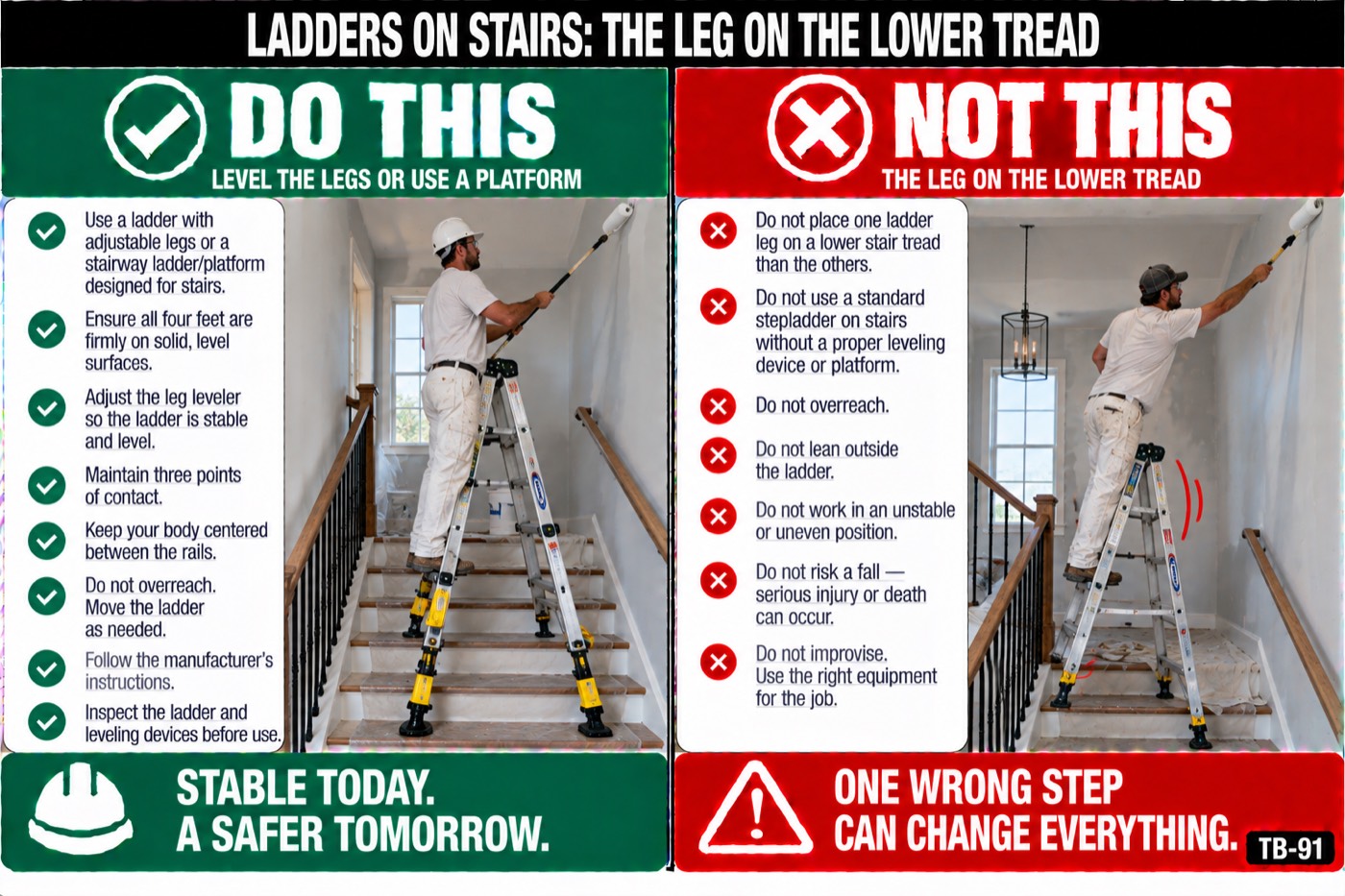
A stairwell ceiling is 17 or 18 feet above the bottom landing. The stepladder standing on two treads with a paint can under the short leg is what most painters have used to reach it, and it is also what the fall reports describe.
The points
- Stairwell falls are long falls. A ladder that kicks out on a stair tread drops you the height of the ladder plus the height of the stair, onto the treads and the landing, and the extension pole in your hand goes down with you.
- The ladder rule: ladders go only on stable and level surfaces unless secured, not on a slippery surface unless secured or fitted with slip-resistant feet, not in a doorway or passageway unless secured or barricaded, and the top step of a stepladder is not a step.
- On a stairway: a ladder built or fitted for stairs, with leg levelers made by the ladder maker, or a plank between a bakers scaffold with leg extensions and the landing, guardrails on when the platform is 10 feet up. A bucket, a block or a stack of drop cloths under a leg is not a leveler.
- Extension pole reach: the pole moves your weight past the rails, and the ladder goes with it. Belt buckle stays between the rails, the pole reaches what it reaches from there, and the ladder moves for the rest.
- A lift on a slope, a ramp or a driveway: the lift's tilt alarm is not a suggestion, outriggers down where the machine has them, and the manufacturer's slope limit, which for most scissor lifts is only a couple of degrees, decides whether it goes there at all.
Why it goes wrong
A stepladder with one pair of feet on a lower tread and the other on a higher one is standing on a surface that is not level by 7 inches, and the ladder rule says level or secured. The fix is a ladder with adjustable legs from the manufacturer, a stair-specific articulated ladder, or a work platform built for stairs. Anything improvised under a leg shifts when the load shifts.
Over an open area, the plank and the bakers scaffold are the tools. A bakers scaffold with adjustable legs stands on the landing or on the floor below with the platform at the height of the ceiling work. Above 10 feet the scaffold rule wants guardrails, and the casters lock before anyone climbs. A plank from a stair tread to a scaffold rail with no support in the middle is a diving board.
1926.1053(b)(8) covers doorways and passageways: a ladder placed where traffic or work can knock it gets secured or barricaded. A stairwell is a passageway. The crew member carrying a 5-gallon bucket up the stairs is the traffic, and a ladder standing across the stairs with nobody watching it is the one that gets bumped.
The extension pole is the reason painters fall off ladders that were set correctly. Rolling out at full reach puts the pole, the roller and the wet paint 4 or 5 feet past the rail and your center of gravity with it. On an extension ladder that is a sideways slide of the top; on a stepladder it is a tip. The rule of thumb is the belt buckle between the rails, every stroke.
Scissor lifts are built for firm, level ground. Most are rated for a slope in the range of 2 to 3 degrees, and the tilt alarm shuts off the drive above that. A lift driven up a ramp or parked on a sloped driveway and then raised is the aerial lift tip-over. Set on the level, chock if the manufacturer says to, and use the machine's own slope rating rather than what looks flat.
The common mistake is the last cut-in at the top of the stairwell. The scaffold is down, the lift is gone, and the finish painter takes a 6-foot stepladder onto the stairs for ten minutes of brush work. The ten minutes are the fall, because everything that made the earlier work safe has already been loaded on the truck.
Questions for the crew
- What stairwell or open area is getting painted today, and what is the plan for reaching the top of it?
- Which ladders on the truck have leg levelers, and which stair ladder or platform is on this job?
- Where is the lift going today, and has anyone looked at the slope where it will be raised?
To close
No ladder stands on a stair tread today unless it is leveled with the maker's legs or secured, and the last cut-in at the top of the stairwell gets the same scaffold as the first coat.
To hold this talk with your crew
1
Read it aloud. Five minutes, before the work starts.
2
Ask the questions. A crew that talks is a crew that remembers.
3
Have them sign on their own phones, and the record is sealed.