Table saw kickback: the board that comes back at you
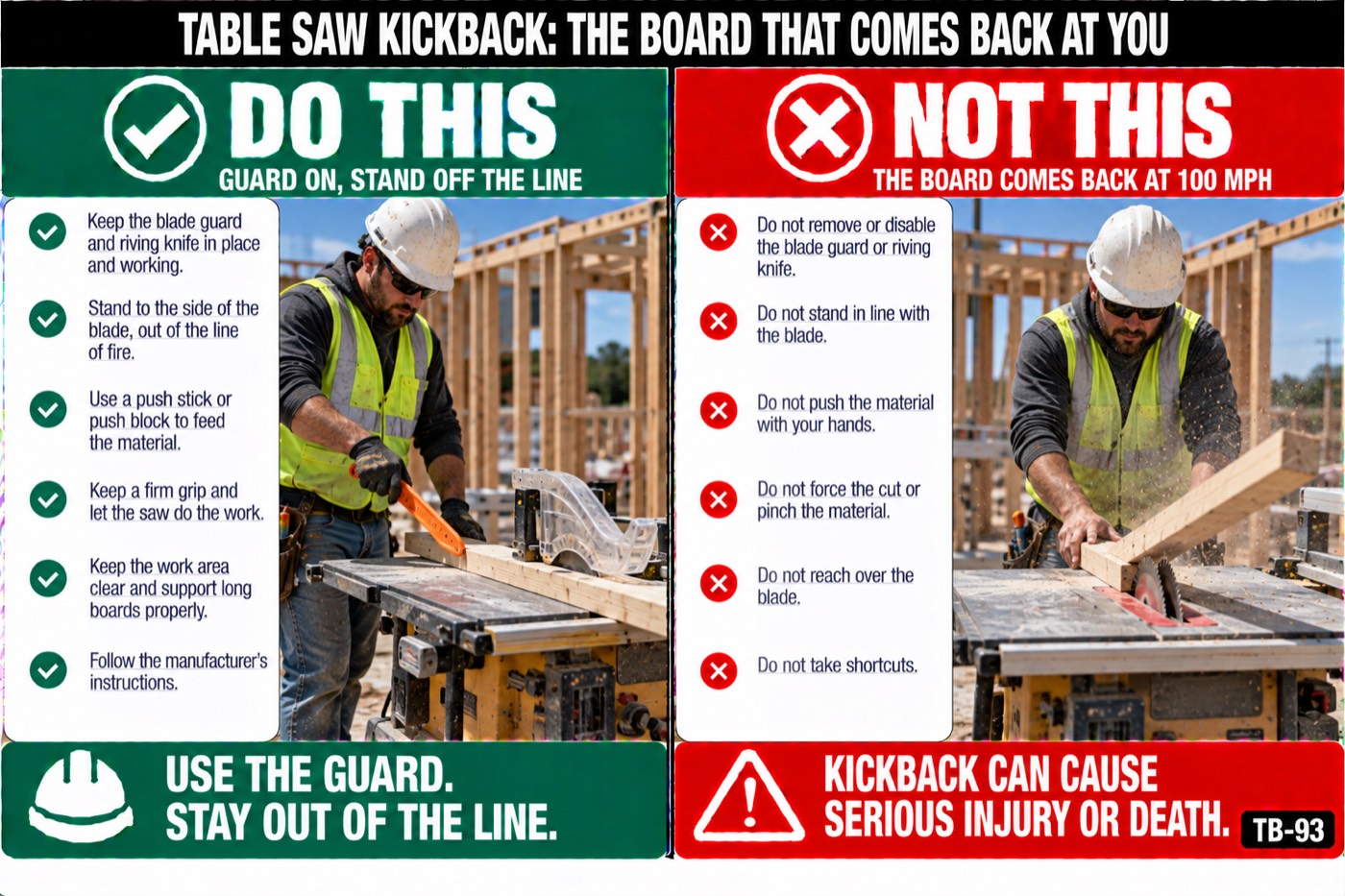
A 10-inch blade at 3,500 RPM has a rim speed of about 100 miles an hour. When the wood pinches the back of the blade, that is the speed the board comes back at your gut, and it happens faster than you can move.
The points
- Kickback throws the board at whoever is behind it at about 100 miles an hour, and if the board lifts, the blade takes the hand that was pushing it. Table saws put around 30,000 people a year in the ER and cost about 4,000 of them a finger or more.
- The rule: the hood over the blade stays on every table saw on this site. The riving knife or spreader behind the blade is what keeps the kerf from closing on the back teeth, and that closing is what starts a kickback.
- The guard that came off for a dado or a non-through cut goes back on before the next rip. A saw with the guard in the truck box is a saw that is not in compliance and not in use.
- Stand to the left of the blade, never straight behind the board. Use a push stick for anything narrower than about 6 inches, and use the fence or the miter gauge, never both on the same cut.
- Let the blade stop before you reach for the cutoff. Never reach over or behind a spinning blade, and never back a board out of a cut with the blade running.
Why it goes wrong
The back of the blade rises toward you. If the board pinches the blade or drifts off the fence and touches the back teeth, those teeth lift the board and throw it at you, and the board rotates as it goes. Your hand was pushing that board; when it leaves, the hand keeps going toward the blade. That is why kickback injuries are so often hand injuries and not bruises.
A riving knife rides in the kerf just behind the blade, moves up and down with it, and keeps the cut from closing on the back teeth. The old-style splitter is bolted to the guard, which is why the guard comes off for one cut and stays off for a year. If your saw has a riving knife, it stays on for every cut, including the ones where the hood cannot fit.
Wet, twisted or case-hardened wood closes on the blade as you cut it. Treated lumber straight from the yard is the worst. If you feel the kerf closing, stop the saw before you do anything else, then back the board out. Rip wet stock with a wedge dropped in the kerf behind the blade.
The kickback line is straight back from the blade. Stand to the side, keep the helper catching the board off to the side too, and keep everyone else out of that line; an offcut at 100 miles an hour has hit people 20 feet away. On a jobsite saw on a folding stand, support the outfeed so the board does not tip at the end of the cut and drop your hand toward the blade.
Check the fence. A fence angled in toward the blade at the back pinches every board you rip. Set the blade so the gullets clear the top of the board, keep it sharp, and use the right blade: a 24-tooth rip blade for solid stock, not a dull combination blade that burns and binds.
The rule in 1926.304 says the hood completely encloses the blade above the table and above the material, adjusts itself to the thickness, and is mounted so it cannot come out of line. The general tool rule in 1926.300 says guards go on when the tool is in use. Neither has a dado exception that lasts past the dado.
Questions for the crew
- Where is the guard for the saw on this site right now, and when did it come off?
- Who cuts on that saw today, and where does the person catching the board stand?
- What are we ripping today that is wet, twisted or narrow, and how is it being pushed through?
To close
The guard and riving knife go on that saw before the first rip today, and nobody stands in the kickback line.
To hold this talk with your crew
1
Read it aloud. Five minutes, before the work starts.
2
Ask the questions. A crew that talks is a crew that remembers.
3
Have them sign on their own phones, and the record is sealed.