Pump jacks: the bracket that was not pinned
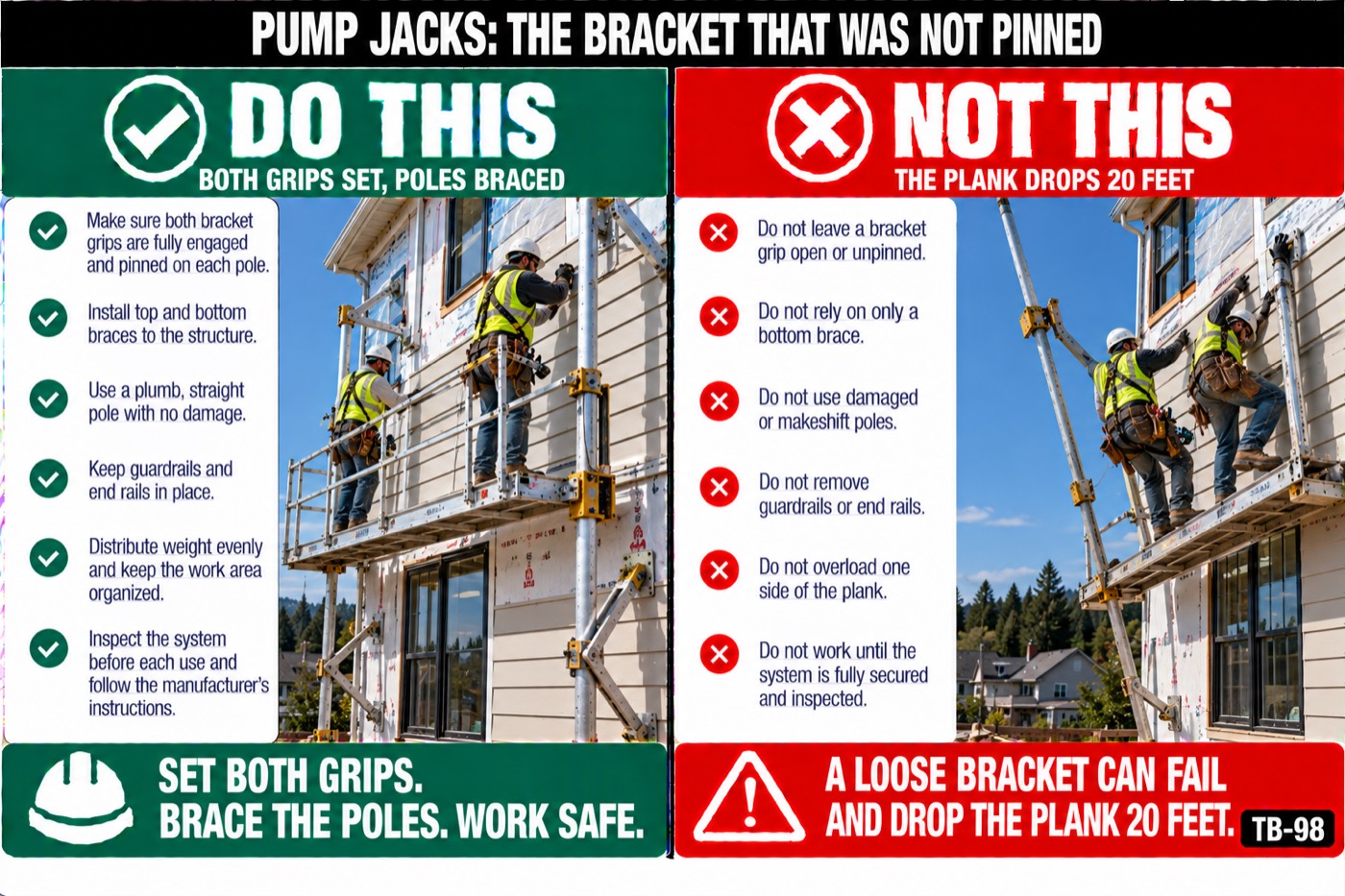
A pump jack platform holds two people and their siding at 20 feet on two brackets and two poles. Each bracket has two grips for a reason: one of them is the one that fails.
The points
- When a pump jack bracket slips or a pole kicks out, the plank drops and the two people on it go with it: 20 feet onto the siding pile, with the plank landing on top.
- Every bracket has two positive gripping mechanisms and both are engaged. Every pole is braced to the wall with rigid triangular bracing at the top, at the bottom, and where the plank stops for work. A pole braced at the bottom only is a pole that hinges.
- The plank is a scaffold plank, aluminum or scaffold-grade, rated for the load, with the ends on the brackets and not hanging past them more than the maker allows. A 2x10 from the lumber pile is not a plank.
- Above 10 feet there is a guardrail or everyone on the plank is tied off. The workbench on a pump jack is a bench, not a step and not a platform.
- The load limit is the manufacturer's, usually about 500 pounds for the pair: two people and a few pieces of siding. Not a saw stand, not a full box of siding, not three people.
Why it goes wrong
The rule for pump jacks is 1926.452(j): brackets, braces and accessories made of metal plates and angles, two positive gripping mechanisms on every bracket, poles secured to the structure with rigid triangular bracing at the bottom, the top, and other points as needed, and the workbench never used as a platform. The general scaffold rules in 1926.451 add the rest: planked platform, guardrails at 10 feet, and a competent person inspecting before every shift.
The failures are simple. The brace mount is nailed to the sheathing with siding nails instead of lagged into a stud or the rim, and it pulls out. A brace gets taken off to run a piece of siding under it and does not go back. A pole is set on soft backfill with no base plate, sinks on one side, tilts, and the bracket binds and then lets go. None of these look like much from the ground.
Poles go on a firm base, plumb, with the bracing at the top, the bottom, and about every 10 feet between, fastened to framing with the fasteners the manufacturer names. Wood poles, where they are still used, are straight-grained and free of large knots and shakes, per the rule; the aluminum ones are what belong on this crew.
A rated aluminum plank spans between the two brackets with 6 to 12 inches of overhang at each end and both ends bearing. Wood 2x10s from the lumber pile are not scaffold grade, deflect under two people, and split at a knot. Pump both jacks up together so the plank stays level; a plank tilted 8 inches end to end is a plank someone slides off.
Working from the plank: hips inside the rail, no leaning out to reach the last course, no riding the jack up with an armload of siding. Go up and down by pumping, not by climbing the pole. Nothing gets stacked on the plank beyond what you are nailing in the next few minutes.
Wall bracket and ladder jack scaffolds fail the same way: the bracket that was hooked over the ladder rung but not pinned, the bracket nailed to the sheathing but not bolted through a stud. If the rule says pin, bolt or brace, the reason is that someone already found out.
Questions for the crew
- Who set up the pump jacks on this wall, and who looked at both grips on every bracket this morning?
- What are the pole braces fastened into, sheathing or framing, and is any brace off right now?
- What is on that plank besides the two people, and what is the plank rated for?
To close
Nobody goes up on that plank today until the competent person has checked both grips on every bracket and every pole brace.
To hold this talk with your crew
1
Read it aloud. Five minutes, before the work starts.
2
Ask the questions. A crew that talks is a crew that remembers.
3
Have them sign on their own phones, and the record is sealed.